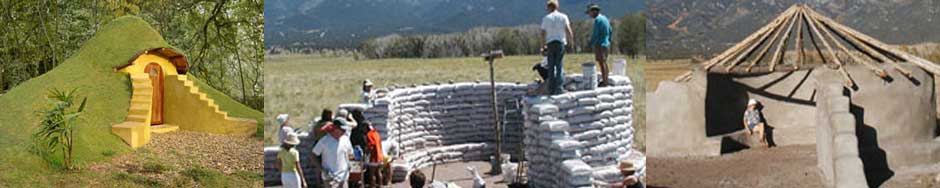
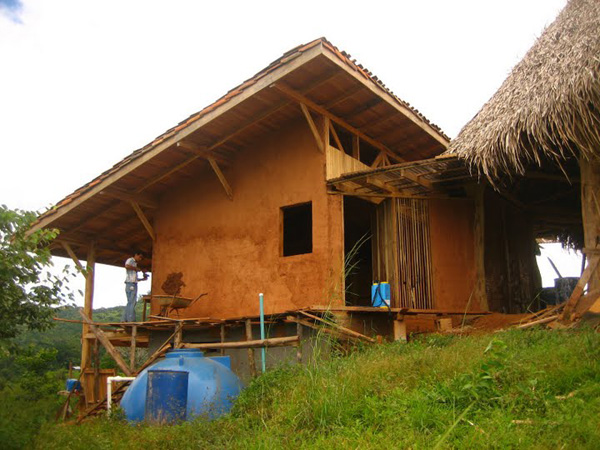
“Finca Las Brisas is an ecologically-focused community. It is a place where environmentally concerned people can own property, live and vacation in better harmony with nature. It is a place where owners can contribute not just to their community but also the surrounding habitat and local communities.
Community
EcoReality Ecovillage
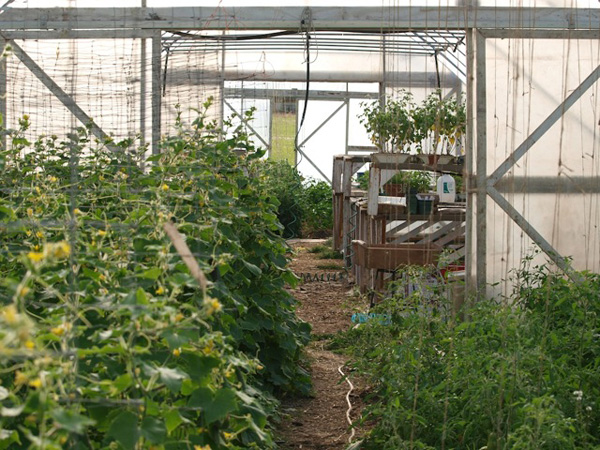
“We are developing an ecovillage in the South Gulf Islands of British Columbia, Canada. The ecovillage is working to be a model of co-operative, sustainable land habitation and land use and features public outreach and education as included goals.
Builders Without Borders – Natural Building in Haiti
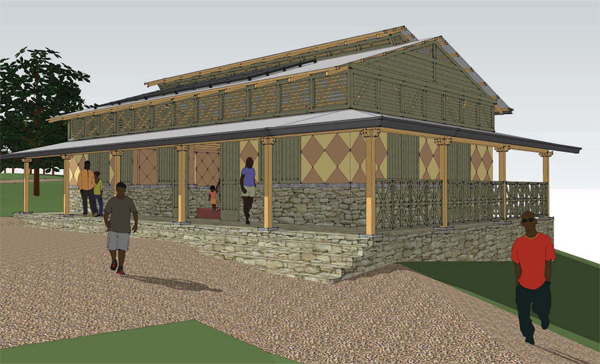
“BWB has partnered with Help Hayti for the design of an Internet & Community Center for the rural community of Terre Froide. It will use local materials (stone, bamboo, earth plasters) and feature photovoltaic and rainwater catchment systems. It is seen as a prototype for other rural communities in Haiti.”
Remodel Green: Make Your House Serve Your Life
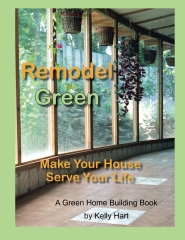 Here’s a book hot off the press! It is always exciting to have the actual book in my hand and see the real manifestation of all those days of work. Remodel Green: Make Your House Serve Your Life is the second book in my series about green home building (the first was Rolling Shelter: Vehicles We Have Called Home) and it chronicles much of the personal remodeling I have done over my life.
I organized the chapters to focus on specific aspects of green remodeling, using examples from my experience to illustrate the points I make. The book is lavishly illustrated with photos from all of those projects, so it is a fun book to browse. My dear friend, Lee Temple from www.PrimaMundi.com, wrote a fine Foreword for the book, placing its message in the greater context of global environmental awareness. To remodel an existing structure to suit your needs is fundamentally a sustainable activity, because it means that you are salvaging a considerable amount of embodied energy rather than causing all of the new embodied energy that any new building would entail.
Universidad de la Tierra (The Earth University)
“Can you imagine: a university that has no pre-requisites? An educational center where you don’t take tests or fill out paperwork, and it doesn’t cost a dime? A place that offers the same scholastic opportunities for indigenous, mestizos, and foreigners? A school where you learn by doing exactly what you want to?
300 earthbag homes for ‘Yolanda’ survivors to rise in Coron, Palawan
From yesterday’s www.businessmirror.com written by Jonathan L. Mayuga:
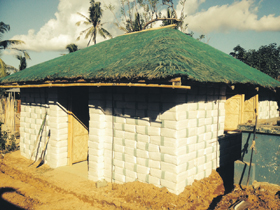
CORON, Palawan—Eco-friendly earthbag homes for Supertyphoon Yolanda survivors will soon rise in Barangay Lajala, one of the coastal barangays devastated by the super typhoon in this island municipality last year.
Mayor Carla “Fems” Reyes said the island municipality is planning to construct 300 earthbag homes for those who remain homeless after Yolanda triggered a storm surge that swept away thousands of houses along coastal towns in Central Philippines.
The earthbag homes, with a floor area of 24 square meter, will have one bedroom, one comfort room and a concrete floor, according to a plan approved by the local government of Coron.
Instead of ordinary hollow blocks, a mixture of cement and soil—one part cement and seven parts soil—was used to make bricks that would be used for the walls of the house. For the roofs, doors and windows, bamboo poles or kawayan and nipa will be used.