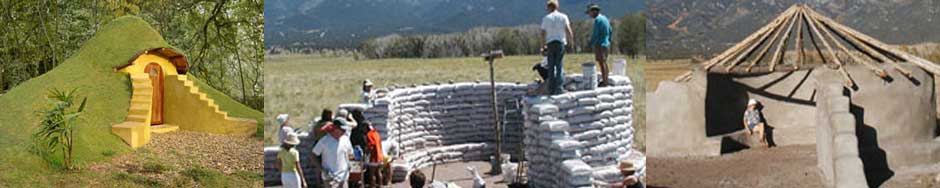

As sustainability assessment lead at Sheffield University’s Grantham Centre for Sustainable Futures, Stuart Walker wanted to make sure his garden office had the lowest possible embodied carbon and low energy use once it was up and running. That meant the office would need to be very well insulated and made of materials with low carbon content.
Straw is a fantastic insulating material. It’s also cheap, easy to work with, and since the straw absorbs carbon dioxide from the atmosphere as it grows, straw buildings act as carbon stores.
His first real involvement with straw building was through the design of a low carbon cold room in Kenya, working with energy efficiency experts and architects from Switzerland and Kenya. A cold room is an easy-to-build and cheap alternative to a large fridge, enabling farmers in developing countries to store produce at a market, improving incomes and reducing food waste.
 This cold room is now operating on the shores of Lake Victoria, Kenya. It has cement-free foundations, solar panels and batteries, water storage, low energy cooling units, a timber structure and straw bale walls. The project showed Stuart that straw bale structures can provide good insulation without the environmental impact of expanded polystyrene.
Straw in bale form has been used for buildings since the 1800s. After the invention of mechanical baler in the US, straw bales were used to construct homes in places where timber and stone were hard to find. Some of these early buildings still exist, but most straw bale houses in the US were built since the 1970s. These buildings offer warm comfortable homes and were the inspiration for a new wave of UK straw bale builders in the 1990s.
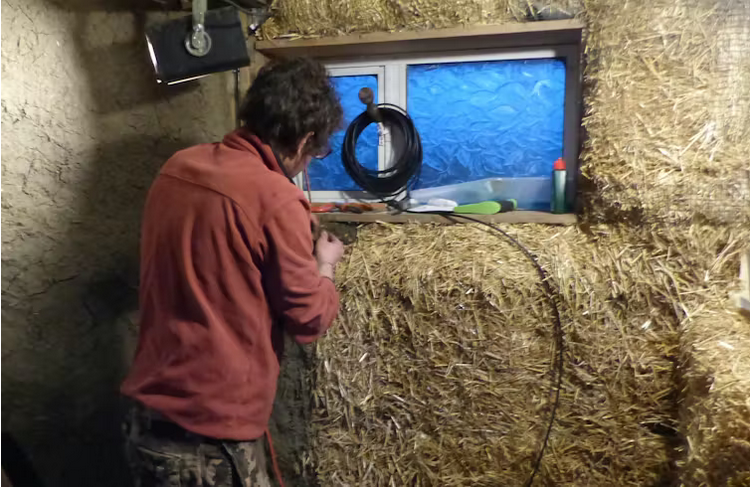 Straw works well for single or two-storey buildings, but requires careful design to avoid water leaking into it. Provided the bale buildings are protected from rain splash at the bottom and have an overhanging roof at the top, water isn’t really a problem. Fire requires oxygen and fuel, so a compressed straw bale is fire-resistant, and straw bale buildings have met all fire, planning, and building regulations, and have achieved extremely high standards of insulation, thermal performance and energy use.
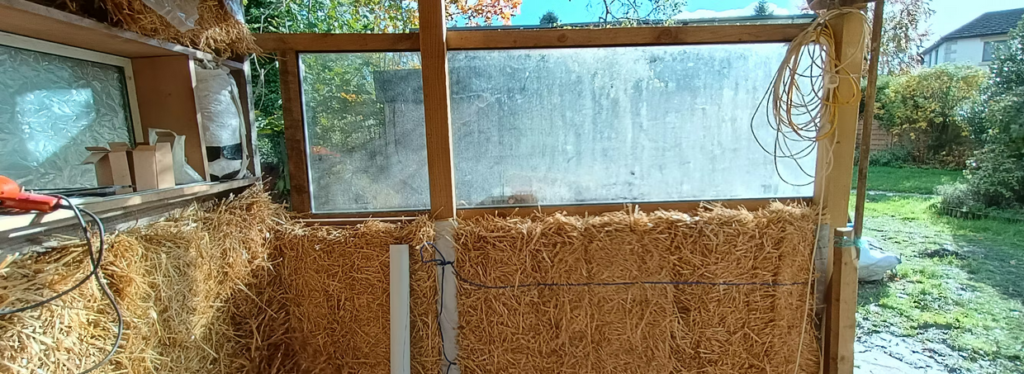 Stuart’s garden office has 40cm (18 “) thick walls and double-glazed windows, is clad on the outside with reclaimed timber and the roof, windows, doors and underfloor insulation are all secondhand. For interior plaster he used cob. Cob is a mixture of clay, water, sand and chopped straw. After digging the clay from his garden and mixing it, he applied the cob by hand.
The lifetime greenhouse gas emissions of his shed will be about 20 tonnes lower than they would have been if he had used expanded foam insulation and plasterboard.
People who live in straw bale houses talk about how the irregular shape and natural materials of straw bale buildings also have a positive impact on them.
You can read the original article at theconversation.com