Mike Creedy just sent me word of his upcoming free earthbag workshop. You might remember the recent blog post about the permitted earthbag dome he’s building in Florida. I’ve pasted a few factoids from his Florida Dome Home Blog.
“We will be hosting a free workshop on site starting Saturday 14 July.
1459 181 road
Live Oak, Fl 32060
Tel: Will be switched on just for you… 386 466 2010
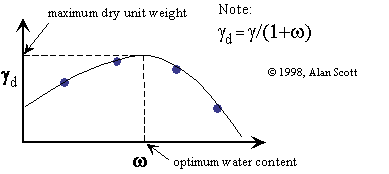
The Proctor Test is used to determine the optimum moisture content in soil, and can help create stronger earthbag and rammed earth structures.
“The Standard Proctor Test is a laboratory test used to determine the optimum water for a given compaction energy, for a given soil. The graph illustrates the results obtained from a Standard Proctor test.
The Proctor compaction test is a laboratory method of experimentally determining the optimal moisture content at which a given soil type will become most dense and achieve its maximum dry density. (Compaction is the process by which the bulk density of an aggregate of matter is increased by driving out air.) The term Proctor is in honor of R. R. Proctor, who in 1933 showed that the dry density of a soil for a given compactive effort depends on the amount of water the soil contains during soil compaction.
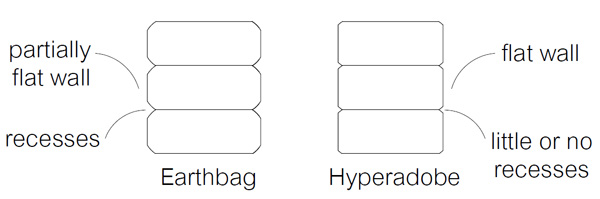
Partially flattened polypropylene earthbag wall (left) versus hyperadobe earthbag wall made with mesh bags or tubes (right)
We discussed flattening earthbag walls in a previous blog post: Flattening Walls to Save Plaster
In that blog post (and the following Comments afterwards) I described some of the basics of this technique: tamp the sides of walls after several courses are complete; don’t wait too long or the soil will dry and be difficult to tamp; use enough clay in the mix so the earthbags are malleable; focus on eliminating awkward bulges; don’t tamp the walls completely flat – leave recesses between courses of bags so the plaster has something to grab onto.
Earthbag outdoor toilet and shower with solar hot water
Richard is an American expat who’s currently living in Laos and Thailand. His Wrong Way Home blog documents his modest home, and his plans for an outdoor toilet and aquaponic system.