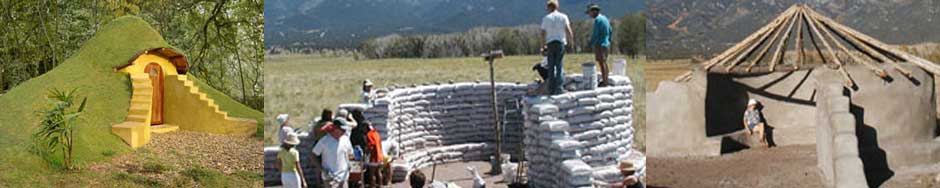
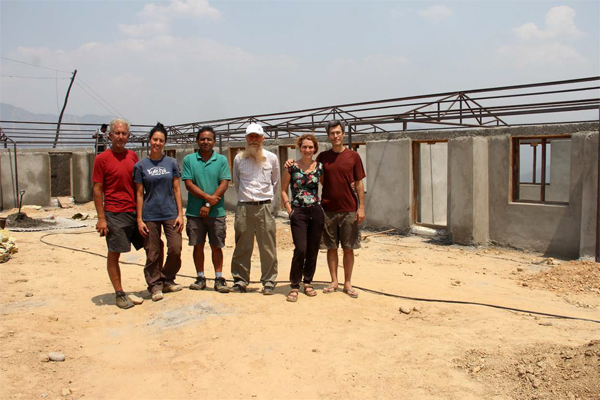
First Steps Himalaya, a New Zealand based NGO, is doing an excellent job on the six-classroom school in Sindhupalchok, Nepal. There was a Spanish documentary film crew on site that interviewed me and asked for my impression of the school. I described the school “as strong as an army bunker. The massive earthbag walls could withstand grenades, rifle bullets and even a crash from a speeding vehicle”. The quality of construction is on par with Good Earth Nepal that organized my trip.
low cost
Hyperadobe Quick Wall Machine
Thanks to Jaime Marin for this excellent find. This video shows how to build and use a handmade tube filler to make hyperadobe (raschel mesh) earthbag walls. The machine holds the funnel in place to help fill the tube and then rolls backwards down the wall. Note how they’re not using barbed wire because they’re using mesh, and the project is probably not in an earthquake zone. By the way, always use barbed wire on domes.
Tiny huts to enjoy the basics in Swedish spartan rural lodge
“For more than 400 years, charcoaling had been traditional industry in the area surrounding Skinnskatteberg, Sweden. Locals burnt charcoal for the iron industry and lived in rustic huts to stay close to the “coaling” process.
The Owner Builder Magazine: Rebuilding Nepal
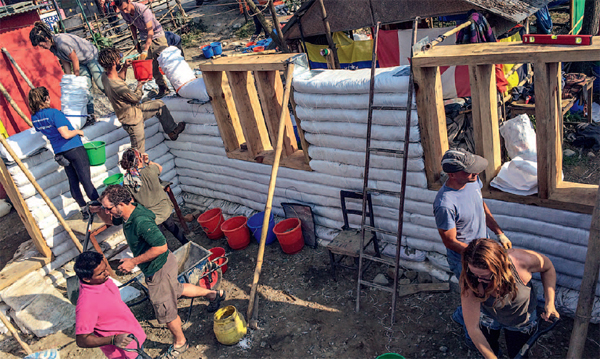
Lynda at The Owner Builder Magazine kindly sent us this excellent article written by Mark Clayton. Full text is available through their magazine or by downloading it from Earthbag Building.com.
The Case for Catenary Roofs

Excerpt from the “Journal of the National Institute of Building Sciences,” February 2016:
“The Swiss civil engineer and contractor Heinz Isler (1926-2009) is regarded as one of the pioneers of shell structures. He gained renown for his experimental, physical methods of form-finding and the resulting expressive shell structures produced in thin-walled concrete, and first triggered his lifelong fascination and professional work with such structures by draping a saturated bed sheet in freezing weather to form a catenary shell before inverting it. He proved that, what gravity forms when inverted, is resistant to the forces of gravity.
Gabion Band Stone Construction
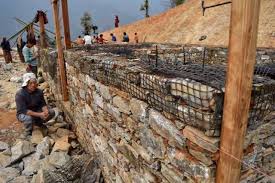
Special thanks to Randolph Langenbach who sent me this information on rebuilding rural stone houses in earthquake zones with gabion bands. The basic concept uses ring beams of stones wrapped in strong mesh to tie the masonry walls together.