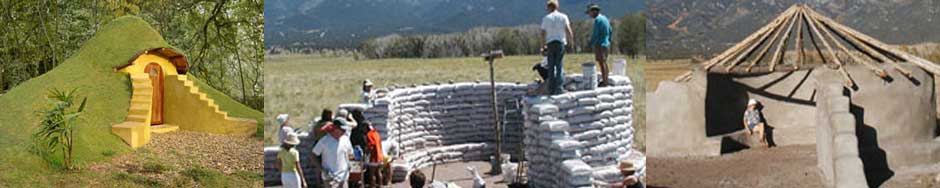
Earthbags Can Be Almost Hard as Rock

Do earthbags really become hard as rock or is this exaggeration? I did a little experiment on the roundhouse we’re currently building to find out. The answer depends primarily on the choice of fill material and the degree of compaction. The moisture content and curing process also play a role. We used road base – … Read more

Roundwood Braces

One way to save money and reduce your impact on the environment is to use unmilled roundwood when building your home. Wood in the round is much stronger than standard dimension lumber and requires less processing. In our case it enables us to use local, sustainably grown wood instead of wood shipped hundreds of miles. … Read more

Sheet Metal Anchors

It seems most people are using wood to attach rough frames (“bucks”) for windows and doors to earthbags. We have termites in our area and so we’re using galvanized sheet metal for this purpose. I’ve used both kinds and discovered sheet metal anchors are much faster to make. The first step is to cut sheet … Read more

Structural Mesh

Wrapping walls in mesh – starting under the first course of bags and going over the top of the bond beam – is a simple way to add a great deal of extra strength to your earthbag structure. Fishing net and plastic lath are ideal for wet climates. Galvanized wire lath or chicken wire is … Read more

Alternative Bond Beams for Straight Walls

My previous post described an alternative bond beam for curved walls; this post is on straight walls. Conventional reinforced concrete bond beams may not be affordable or the materials unavailable. Or maybe you want to reduce or avoid using cement. Here’s one low-tech, low-cost bond beam design. It’s even possible to use salvaged materials for … Read more

Alternative Bond Beam for Curved Structures

Forming bond beams for roundhouses and other curved structures is somewhat difficult. Here’s a brief description of an alternative bond beam that requires little or no formwork. It’s made with two layers of long poly tubes filled with stabilized soil (non-seismic zones) or concrete (seismic zones). Tubes could be filled 3″-4″ thick to save on … Read more