
While floodwater once signalled an immediate retreat for coastal communities, today’s delta regions are viewing rising tides as a signal for radical redesign. Where great rivers finally meet the tide, flooding has become a constant pulse shaped by rising oceans, heavier rains, and land that is quietly sinking beneath our feet. So how do you build so life can continue when water arrives? Floating bamboo solar shelters can fill this practical gap.
Deltas are the unpredictable collision points where fresh water, salt water, and human settlement constantly overlap.Traditional foundations and even stilted homes fail when the soil beneath them simply dissolves or a storm surge ignores the previous record high.
Silent saltwater intrusion can gradually claim stands of trees that once stood on stable, dry ground. Local decisions about where to store essentials, how to reach school, and whether a “dry season” can still be trusted reflect this changing reality.
Mangrove buffers that blunt storm surges are vital for reducing wave energy and trapping sediment. This is precisely why flood-zone housing must coexist with water rather than clearing more land to escape it.
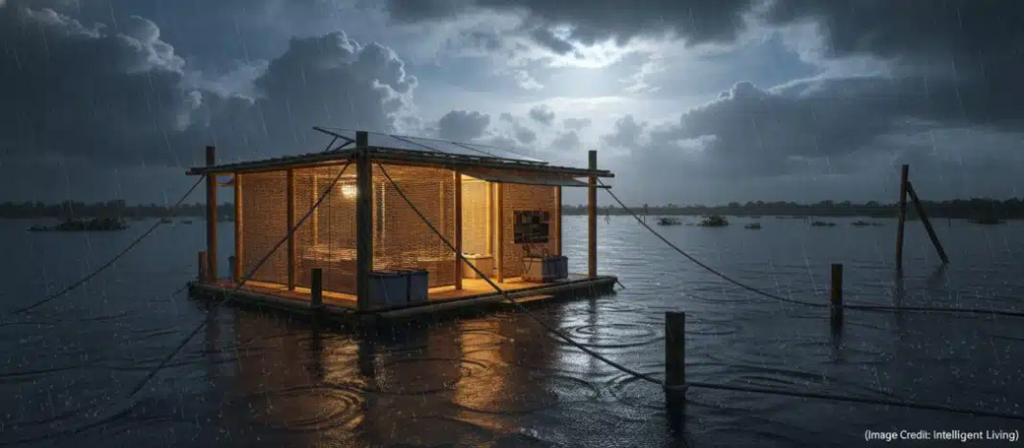 A floating bamboo shelter concept originally introduced semi-permanent microhomes for crews in flood-prone zones. Units sit on buoyant platforms while utilising rooftop solar for energy. When access roads disappear under flood pulses, boats become the corridor. A floating basecamp that can be repositioned along waterways works like a mobile operations node, not a static cabin.
Bamboo offers a unique set of advantages for flood-zones: When selected with care, its strength-to-weight ratio easily rivals modern composites. Its natural flexibility allows structures to absorb environmental stress without fracturing.
Bamboo varies by species, age, and treatment, and durability becomes the deciding factor for service life.
Flood-prone regions are often hot and humid, so comfort is not a luxury detail but a foundational requirement. In these environments, the difference between a productive day and a complete logistical failure often rests on the ergonomics of the workspace. Ventilation, shaded decks, insect control, and dry storage determine whether crews can effectively recover between shifts.
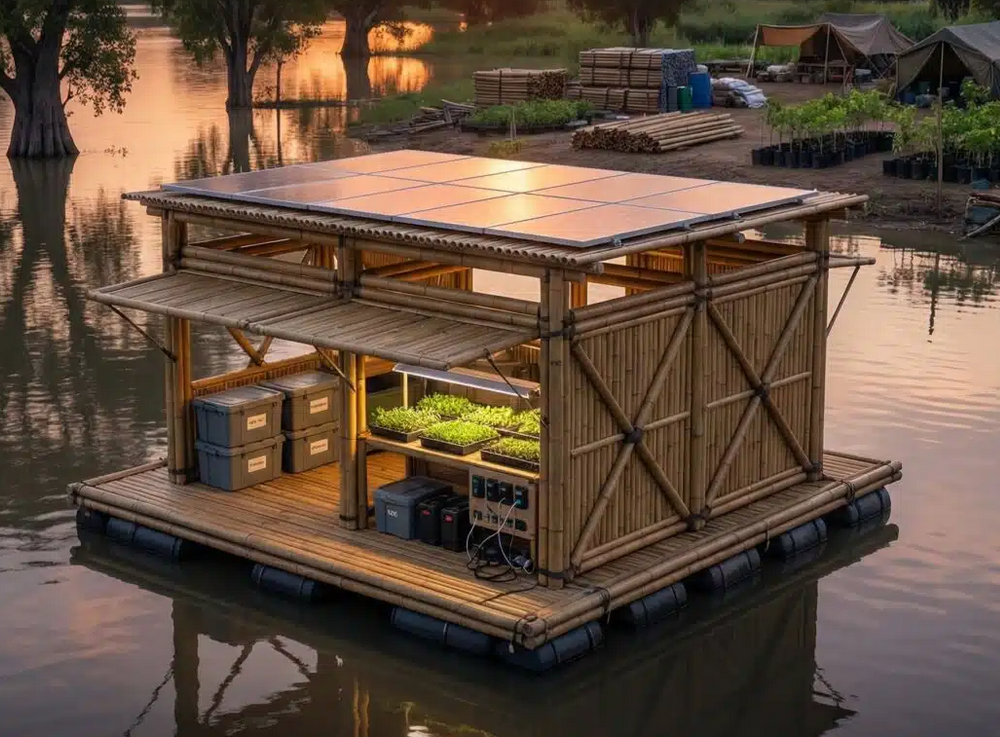 During the height of a wet season, trapped humidity turns timber and fabric into an active mould incubator. It’s a serious risk—without constant airflow, these conditions quickly compromise the health of the crew and the integrity of the shelter itself. Cross-ventilation, high vents near the roofline, and a raised sleeping platform help move moist air out effectively. This is also why simple design choices, such as a roof overhang and a screened porch, often matter more than a heavier wall.
Waterproof bins and hanging racks are essential operational requirements for off-grid solar base camps. Such storage solutions protect sensitive electronics and medical supplies from moisture failure.
Anchoring systems should allow shelters to rise and fall with water levels while resisting drift in wind and current. Amphibious designs often rely on a practical trio: buoyancy, guidance, and restraint. Research on amphibious foundation design components describes how a buoyancy element lifts the structure, vertical guidance posts keep it from drifting sideways, and a structural subframe ties loads together so the cabin does not rack and twist as the water rises.
Flood-focused shelter guidance also emphasises practical details that are easy to overlook at the concept stage, including drainage, raised or protected sanitation systems, and site planning that assumes water will return.
In flood-prone waterways, material choices also carry ecological consequences. Decking, flotation, and fasteners can leach or degrade if the wrong materials sit in warm water for years, which is why the principles of environmentally responsible marine construction map surprisingly well onto the selection of floating shelter components.
In Bangladesh, an amphibious bamboo school designed for flood seasons demonstrates a hybrid approach, operating on land during dry periods and rising with floodwater when the season turns. Rather than treating flooding as an exception, the building is segmented so modules can handle changing conditions without the whole structure becoming fragile.
Water-based structures are also becoming more familiar in public imagination, from floating homes designed for high-water living to modular platforms used for agriculture. A striking example is floating greenhouse modules that can produce food and freshwater, which underlines why “floating infrastructure” is increasingly treated as a toolkit rather than a novelty.
A shelter without power remains a simple platform, but integrated solar arrays transform it into a sophisticated operational node. This energy independence allows crews to maintain critical functions regardless of their distance from the mainland grid.
On the design side, solar and water infrastructure can reinforce each other. Shaded roofs reduce indoor heat load, rainwater capture can reduce supply trips, and compact filtration can lower disease risk. Even outside floating arrays, water-adjacent generation strategies like solar over canals that can cut evaporation while producing electricity show why “energy plus water” is increasingly treated as one planning problem.
If a shelter can pass through a storm season, keep tools dry, keep power alive, and avoid creating new waste or pollution, it stops being an architectural concept. It becomes restoration infrastructure built from next-generation construction materials that can survive a changing water line.
You can read the original article at www.intelligentliving.co