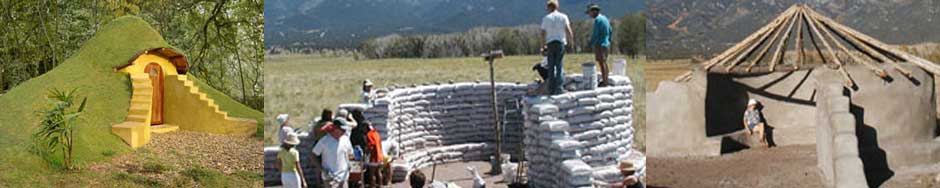
Researchers at the University of Pennsylvania are using food scraps to create environmentally friendly alternatives to concrete and epoxy while also reducing the waste going into landfills.
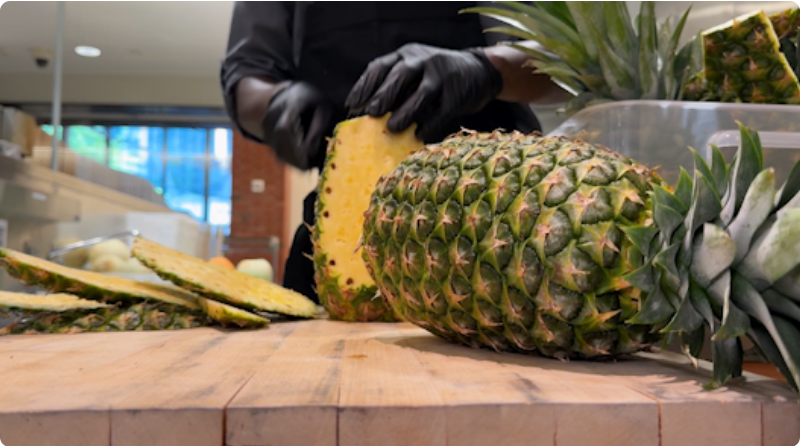 First, inedible fibrous and woody materials from plants are collected from the university’s farm on campus. Okra was one of the crops used in the project. Then, senior researcher Yasaman Amirzehni picks up pineapple and melon scraps from the kitchen. Each day, about 15,000 meals are made in dining halls at Penn. More than 90% of the food waste from those meals is composted, and the rest is collected and given to the school’s DumoLab.
The food scraps and stalks are brought to the lab where they’re dried, ground up and mixed with various natural binders and fillers leading to a compostable alternative to cement or epoxies. “Can the building environment be made out of stuff that nourishes the planet instead of depleting it at the end of its life?” the Lab diredtor asks. “What we do at DumoLab is what architectures can be proposed with only natural materials and natural binders. So, can we build without pouring cement and epoxies and formaldehydes? Instead, use binders in nature that can assemble natural materials into a future where Earth can digest the architectural realm.”
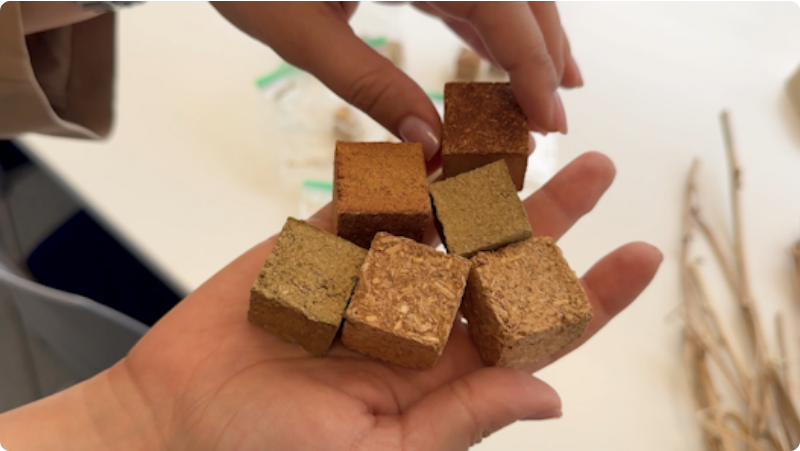 This isn’t about making skyscrapers necessarily. These biodegradable materials can be used to make shingles, shaded areas, pavers and even furniture parts. It’s all repurposed to serve an environmental purpose.
The compostable materials have been tested against the elements. “We are quite successful,” the director said. “We’ve been able to check the accelerated weathering of many of our samples. And we see that in 50 years, depending on what we do with these biopolymer systems prevail. They only change color or only change patina.”
“My goal would be to see if we can change the unhealthy materials to these materials and get back the soul and the colors and the feelings and like the soul of the buildings, instead of using concrete.”
You can read the original article at www.cbsnews.com