
Ebiobambu is a School of Bioarchitecture and Experimental Research and Technology Center for Bamboo in the mountainous region of Rio de Janeiro. They developed an approach that integrates agroforestry cultivation, research on construction techniques, and training of specialized labor.
The main species used in Ebiobambu’s projects is Guadua bamboo. one of the best structural bamboos in the world. The poles can reach between 15 and 20 meters in length with diameters of 10 to 15 centimeters, offering mechanical resistance comparable to steel in tension and to concrete in compression.
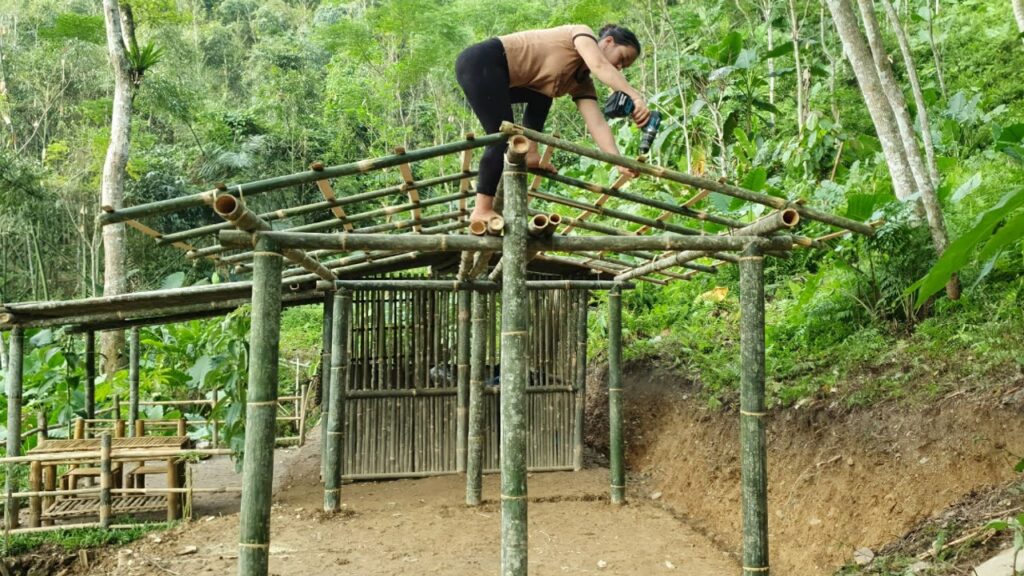 The construction method employed by Ebiobambu is based on ancient Japanese carpentry techniques adapted to the characteristics of bamboo. The connections between pieces are made through precise fittings tied with polypropylene ropes, completely eliminating the need for nails, screws, or synthetic adhesives. This system provides structural flexibility that allows it to absorb movements and vibrations without compromising the integrity of the building.
 One of the most emblematic projects of Ebiobambu was a 255-square-meter residence where the main structure of the house uses Guadua bamboo poles with diameters between 12 and 15 centimeters forming portals that support the roof and distribute loads to the foundations. The internal dividers use thinner bamboo woven together, creating lightweight yet strong panels that allow for space reconfiguration according to the future needs of the residents.
The time to build the complete structure was approximately 90 days, significantly shorter than the 6 months typical for a conventional construction of the same size. This speed derives from the prefabricated nature of the system where connections can be prepared in advance and the assembly occurs like the fitting of ready components, similar to a large modular structure.
The exceptional mechanical properties of bamboo derive from its unique anatomical structure. The poles are hollow cylinders internally reinforced by nodal diaphragms that function as structural ties. This optimized geometry distributes stresses uniformly along the cross-section, maximizing strength with minimal material weight. This combination of high strength and low weight gives bamboo excellent performance in regions subject to strong winds or seismic shocks.
The natural flexibility of the material allows it to absorb impact energy and vibrations without catastrophic rupture, a behavior known as ductility. Well-designed bamboo structures deform under extreme loads but rarely collapse abruptly, providing additional safety margin.
The most common method of preservation employed by Ebiobambu consists of immersing the poles in a solution of borax (sodium borate) and boric acid, natural salts that penetrate the fibers of the bamboo making them indigestible to insects and inhospitable to fungi.
 Properly treated bamboo with borax and protected from direct rain through generous eaves can last 50 years or more without significant deterioration. Durability primarily depends on the quality of treatment and on the design that prevents moisture buildup.
The hollow structure of bamboo poles provides thermal and acoustic insulation properties compared to solid materials of the same thickness. The air trapped inside the culms acts as a barrier that hinders heat transfer and sound propagation, creating more comfortable interior environments without the need for artificial conditioning.
During its rapid growth, bamboo absorbs large amounts of carbon dioxide from the atmosphere through photosynthesis, storing carbon in the biomass of the poles. When bamboo is incorporated into buildings, the carbon remains sequestered throughout the lifespan of the construction. At the end of this period, the material can be composted, returning nutrients to the soil, or burned as renewable biomass. In either case, the complete cycle maintains a favorable carbon balance compared to cement, steel, or plastics.
The inherent modularity of the bamboo construction system facilitates future expansions and layout modifications. Partition walls can be removed and repositioned, roofs expanded, and environments reconfigured with relatively simple interventions.
You can read the original article at clickpetroleoegas.com