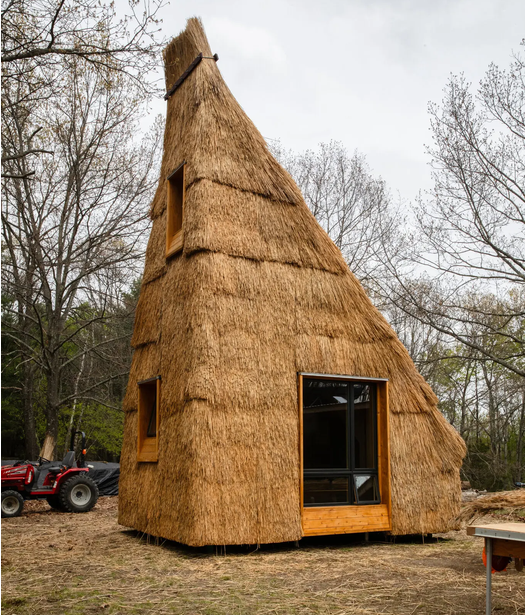
Near Hudson, N.Y., a Princeton University team has erected a cottage made almost entirely of straw, which they said is more sustainable than bricks or concrete. The cottage looks straight out of a children’s book but has some elegant, modern flourishes.
 Straw, which consists of the leftover stalks of cereal grains such as wheat and rice, is ubiquitous, affordable and a natural insulator. And unlike hay, it has no nutritional value. Straw is usually left to biodegrade or, more often, is burned, releasing greenhouse gas emissions into the atmosphere that contribute to global warming.
Straw itself sequesters carbon dioxide, meaning it captures and stores the potent greenhouse gas, whereas making bricks and concrete releases it. So building with straw is much less harmful to the environment. Wood also stores carbon, but chopping down trees is not as sustainable.
The straw house is 28 feet tall and has a sleeping loft, a daybed, five windows and a kitchen. It will be used as a guesthouse by the five families that jointly own the land.
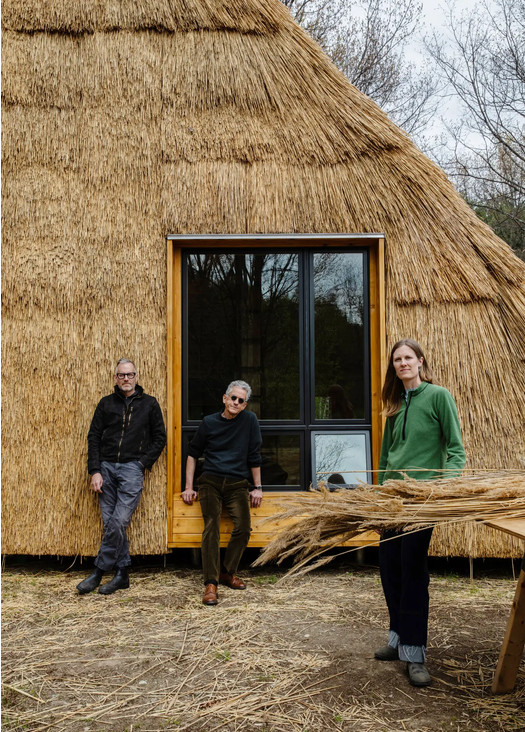 A heat pump, powered by a battery system on the premises and solar panels atop a trailer next door, provides heating and cooling. It is the culmination of three years of research, manual labor, and trial and error.
The straw house near Hudson features compressed straw — where the loose and airy stalks are packed tightly together using heat — as both insulation and building block, without hiding the material behind plaster or wood.
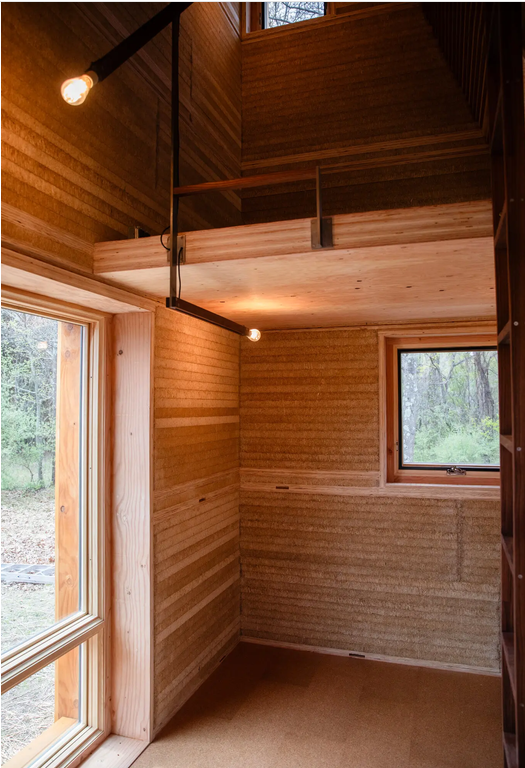 Inside the home the straw remains visible, like exposed brick. On the exterior, the house looks like the perfect domicile for a fairy-tale witch, or three bears. But inside, its clean lines and layers of cut-up straw panels, many of them stacked on an angle, evoke modern minimalism, with custom lighting and large windows with views of the land.
Chris Magwood, a manager of carbon-free buildings for RMI, a sustainability nonprofit, had heard of the project. “It was a cool thing to try,” he said. But he noted that adding a simple wooden frame or using entire sheets of strawboard instead of cutting it into pieces would have made the whole exercise much easier and still would have minimized the use of wood.
The goal was to compress straw bales to create sturdy building blocks that would not require a house frame or a plaster coating. During the summer of 2023, team members experimented with a compressing machine, but failed to achieve a density that they could replicate easily. The next year, they decided to experiment with prefabricated, compressed strawboard, which had been used for interior partitions and ceiling panels since the 1940s, but was not widely considered to be a load-bearing material.
The plan was to cut the boards — which are three times as dense as typical straw bales — into pieces and stack them. Team members, including eight students, first used this technique to build what they called “the doghouse,” a miniature version of the 150-square-foot house they intended to build.
Next came the full-sized tiny house, which was built in components over two months on the Princeton campus. Team members used the strawboard pieces to assemble 16 sections of the house, which were then shipped to the land outside Hudson and put into place with a crane over two days.
The team opted not to dig a basement in order to avoid concrete’s carbon problem. Instead, metal poles were driven into the earth to provide a solid base for the house and lift it a foot and a half above the ground. A permeable membrane that blocks rain from entering the home while allowing trapped moisture to escape was wrapped around the strawboard frame.
The last step was covering the house with thatch, a roofing technique that uses water reeds or wetland grass and was popular in Northern Europe. Team members considered using phragmites, an invasive species from Europe and Asia that is common throughout New York. But they concluded it was too difficult to harvest.
So they worked with a thatch expert from Virginia to supply the product and to teach them how to put it together. Earlier this year, they finished covering the house with about 4,000 pounds of thatch, which was sprayed with a nontoxic fire retardant.
Strawboard, for its part, is fire-resistant and only chars, while its density keeps out vermin. Inside, it’s easy to see how the layers work and how the sections fit together. Mr. Magwood, of RMI, said he appreciated the aesthetic the architects were going for, but that the exposed strawboard should have a protective covering, because it had been cut into smaller pieces, which can make the product shed.
“If anyone rubs that wall, you’re going to get a little shower of straw,” he said. Mr. Lewis said this would not happen because the walls are densely compressed and have been sanded smooth, plus any parts of the strawboard that might loosen up some debris face away from the interior.
Inside the house, a minimal amount of wood was used for the loft ladder, a kitchen counter and a daybed. Mr. Lewis said that less than 10 percent of the house’s structure is wood. The thatch could last up to 40 years. But the home, he said, should survive indefinitely.
Mr. Lewis said that there was no limit to how large a strawboard house, built with this technique, could be. The Princeton team built small because they had a grant of $150,000, most of which went toward paying the student workers.
Nolan Hill, a 30-year-old architecture graduate student who worked on the project, sees the potential of tiny strawboard homes. He compared assembling the components of the house to putting together IKEA furniture (although mastering thatching was more complicated and a bit messier, he said). “It seems like something that people could do by themselves,” he said. “I could see it popping up in people’s backyards, for maybe a mother-in-law house.”
You can read the original article at www.nytimes.com