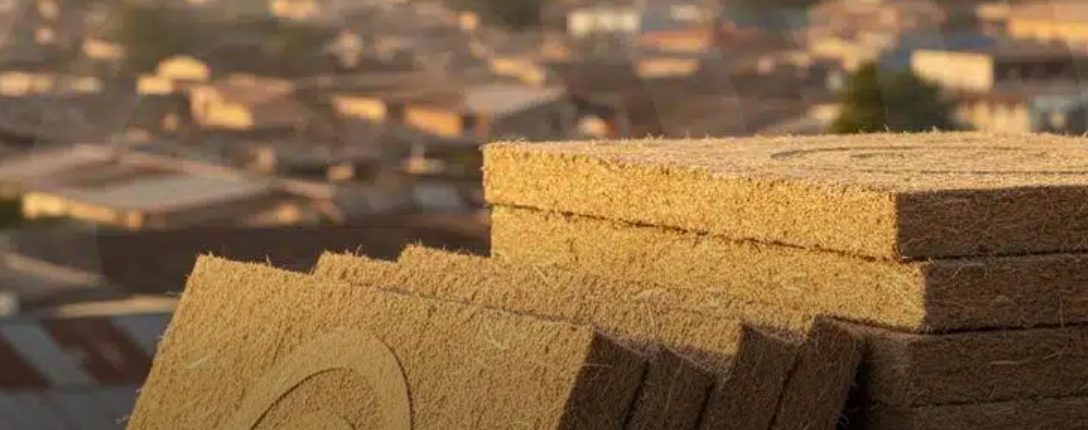
A small home in Kenya has successfully used insulation panels grown from farm byproducts and fungal mycelium. A homeowner invested roughly 208 US dollars into these innovative mycelium building panels. This shows that affordable wall alternatives are achievable without relying on imported plastics or synthetic foams.
 Lightweight mycelium building panels can also reduce the number of vehicle trips needed for a build, which lowers transport costs and reduces construction emissions.
Mycelium is the root-like network of fungi that naturally binds organic matter. In controlled production, it can fuse agricultural residues into rigid panels. Utilizing sugarcane residue and other agricultural byproducts, such as coffee husks and corn cobs, provides a high-volume feedstock for sustainable mycelium building panel composite manufacturing.
 The manufacturing process follows a precise biological sequence: Cleaning and preparing agricultural residues; Placing the prepared material into specialized molds; Inoculating the mixture with fungal mycelium; Drying the composite to stabilize the natural binder. Technical precision is vital during the manufacturing stages, specifically regarding consistent particle size, moisture regulation, and uniform curing, because insulation performance changes when density changes.
Tests show their thermal conductivity is competitive with traditional foam, keeping homes naturally cooler in tropical climates.
Mycelium naturally forms a protective char layer when exposed to heat, offering superior fire resistance compared to many synthetic polymers.
While moisture resistance is a challenge for bio-composites, proper sealing and breathable wall designs allow these panels to function effectively in humid environments.
You can read the original article at www.intelligentliving.co