
Building upon the chemistry that oysters use in miles-long reefs, scientists have found a way to create cement that is stronger and cures faster.
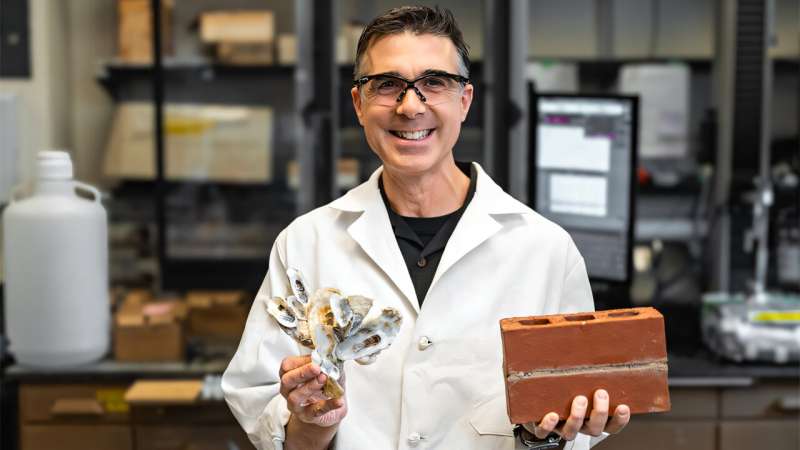 Jonathan Wilker, a professor of chemistry in Purdue University’s College of Science has long been interested in formulating new, more sustainable and better materials. “Our lab studies materials that shellfish make,” Wilker said. “Oysters generate a natural cement. They use this material for attaching to each other when building reef structures. We have been working to understand what oyster cement is and what makes it such a strong adhesive.”
While the words are commonly confused, cement and concrete are not synonymous. Cement is the adhesive—the binding agent—and a component in concrete. “Concrete is the single most produced man-made material,” Wilker said. “It’s everywhere. Traditional concrete is strong in compression, but it can be brittle and weak in other ways. By using technology from shellfish, we may be able to enhance performance and increase the sustainability of cements and concretes.”
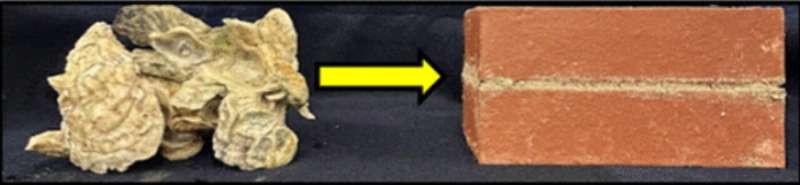 The oldest human concrete is nearly 7,000 years old, but oysters have been building with concrete for more than 200 million years. “The substance that oysters use to bind themselves together is predominantly inorganic in nature,” Wilker said. “It’s mostly calcium carbonate—what we would think of as chalk. Such inorganics are not typically adhesive. But the oysters have combined these inorganics with a modest 12% of organic materials to make a material with impressive properties, including an ability to stick in water.”
Most commercially available adhesives are organic. Rather than meaning that they were grown without pesticides, in the field of chemistry, “organic” means that they contain the elements hydrogen and carbon—the basic building blocks of life on Earth. Plastic, oil and fossil fuels are all organic, along with almost anything that is or was alive.
“Most of the adhesives that you see at the hardware store are made of organic compounds derived from petroleum,” Wilker said. “Oyster cement has about 12% of organic compounds to help bind together the inorganics. So this oyster cement is quite unique. We have been working to figure out how this material functions and if we can develop high-performing mimics.”
To stay as true as possible to the oyster system, they bought bathroom tiles made of limestone—calcium carbonate like what oysters’ shells are made from—and began to experiment.
The team shaped sugar cube-sized blocks of cement and tested them to measure their compressive strength—how much pressure they could withstand before they shattered. Then they bound several of the bathroom tiles together with their biomimetic cement and tried to pull them apart, measuring the force it took to do so. In almost every test, the tile itself broke before the bond between tiles gave way.
Once they had a recipe they thought approximated the oysters’ winning formula, the team went to the local hardware store and picked up a bag of commercially available just-add-water concrete mix. When they added a polymer from their cement to the mix, the resulting material adhered 10 times more strongly, and the compressive strength doubled. And cured faster.
Wilker and his team hope to continue to improve the performance of their patent-pending cement as well as continue pursuing how to make this material more accessible, more sustainable, more carbon-neutral and more affordable. “New cements like this one may be able to further enhance some of the mechanical properties of traditional cement,” Wilker said. “There is so much more that we can learn from nature and so many new materials that we can design.”
You can read the original article at techxplore.com
Who knew oysters were hiding construction secrets in their shells? Stronger, faster‑curing cement sounds like the ultimate DIY upgrade—just don’t tell the seafood platter. Love how science keeps borrowing tricks from nature. Next thing you know, clams will be teaching us about waterproof roofing!