Stepped Earthbag Foundations

One of our readers requested information on how to build on sloped terrain. They want to minimize excavation work. The drawing above shows how to build an earthbag foundation in ‘steps’. The basic process involves: 1. determine the slope of the land: change in elevation (‘rise’) over horizontal distance (run), expressed as a fraction (example: … Read more
Exciting Earthbag Project in Chile

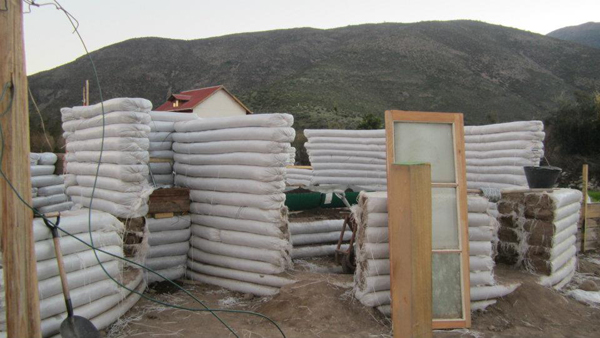
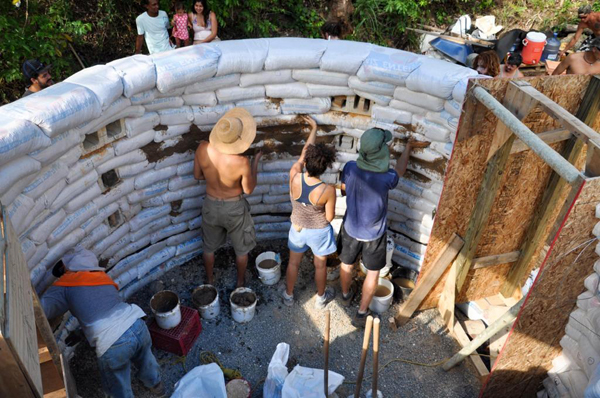
Earthbag project in Chile

Thanks to Paul Coleman (who’s building his own earthbag house in Patagonia) for sending info about this earthbag project in Chile. Paul and his wife Konomi just won an international sustainable living contest. A film crew is coming all the way to Patagonia from Japan to put them on National TV. Check out their blog. They must surely live in one of the beautiful places in the world. Please send us your tips. Our email address is at the top of the page.

Read more

Proctor Soil Compaction Test

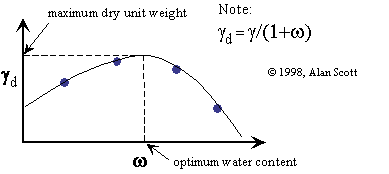
The Proctor Test is used to determine the optimum moisture content in soil, and can help create stronger earthbag and rammed earth structures.

“The Standard Proctor Test is a laboratory test used to determine the optimum water for a given compaction energy, for a given soil. The graph illustrates the results obtained from a Standard Proctor test.

The Proctor compaction test is a laboratory method of experimentally determining the optimal moisture content at which a given soil type will become most dense and achieve its maximum dry density. (Compaction is the process by which the bulk density of an aggregate of matter is increased by driving out air.) The term Proctor is in honor of R. R. Proctor, who in 1933 showed that the dry density of a soil for a given compactive effort depends on the amount of water the soil contains during soil compaction.

Read more