
This article was written by Bharat Arora and can be found at www.travelandleisureasia.com
The year was 2010. I was living in Mumbai. To most, I was in a great place—working with a channel, hosting Band Baajaa Bride, bringing back a nice fat pay cheque every month, and on the precipice of celebrityhood. But the truth is, I was kind of done with the monotony that my life was settling into. I was bored. So, I moved to Goa.
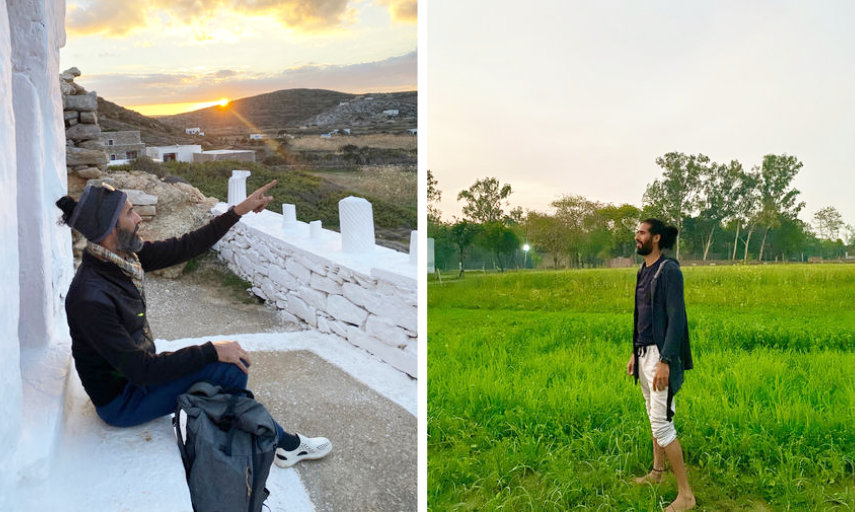 For five years, I lived there—making huts out of trash, recycling, upcycling, and growing our own food. We ended up doing a lot of things that were not so familiar and popular to the world at the time. I think I’ve always been a child of the Earth, but this was where it quietly began for me. There was just a quiet discomfort with the life I was living, and a need to feel something more real.
And somewhere in the middle, a conversation with my father, sitting at what is now our farm in Gurgaon, hit home. He said, “You know, son, I’m not a fortune teller. But I can see that in some time from now, people who can grow their own food will be cool again. People who can till the land, who can grow and sustain on their own, will be kings.” Looking back, I would say this was the absolute conscious advent into this way of life. And the reality is that he was a visionary. I looked around, and things were just getting worse—climate change, the quality of food, sickness, and diseases. In 2014, I proposed starting an organic farm on that land.
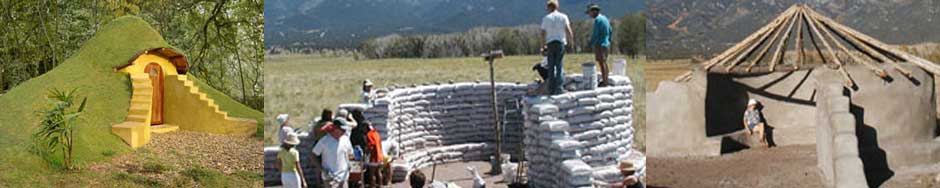
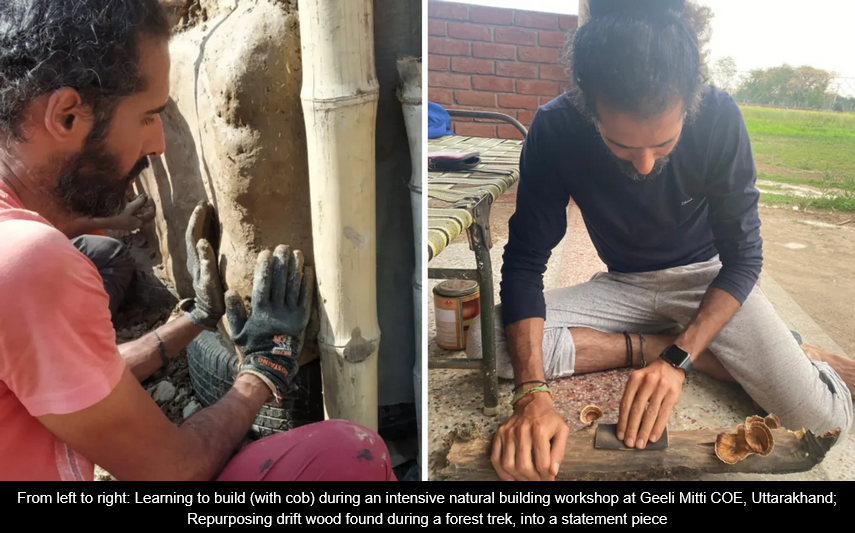
So, I went off to pursue my certification. I did my first certification in organic farming at an institute in Uttarakhand. Then I went into natural building, which I learned over several years from a place called Geeli Mitti Centre of Excellence. Then I went ahead and did my certification in permaculture, which covers regenerative living. Everything I know about organic farming and natural building, I learnt in Uttarakhand.
I had kind of come into this awareness that the world is going, and even though I am a speck in the universe, I have to make the effort. I have to be one of the few, then the many, and then the millions who are now waking up to the reality that this planet needs to regenerate. Now don’t get me wrong—I say this with a lot of humility. But the planet doesn’t need us to repair it. I’m very humbled when I say this because the planet doesn’t need us to repair—it heals itself again and again. But human interference is inevitable. It is about how humans are interfering—are disrupting natural systems to deplete and consume or to regenerate? There’s no third choice.
It’s a bit uncomfortable to admit. But it’s true. I think members of my family might just launch a book at me for it. Very early on, I started to implement certain practices into our daily lives, whether that was switching from chemical-based cleaning products to bio cleaners, or going door-to-door around every house in my colony to ask people to segregate their waste, or urging relatives to stop using single-use plastic. I remember getting impatient at times. But humans, including myself, are hooked on convenience. But you have to take small steps every day. I don’t think everyone can have a singular method of regenerative living. Not everyone has to start farming or natural building. But everyone can carry their own grocery bag. Everyone can reduce the wastage of water in their own home. Everyone can grow a few herbs and spices in their kitchen window. It all adds up.
 In 2015, with the passing of my father, I moved back to Gurgaon and completely immersed myself into this work. And a few years later, in 2022, is when we started to build the farm. And we built it ground up—starting from regenerating the soil, working with the land and then building naturally on it. Today, it’s a living entity. It’s not something you set up and leave. It’s an everyday, ever-going project. There is nothing more therapeutic than working with your hands and tilling the soil, sowing the seed, or turning the compost. It is, perhaps, therefore, that every morning begins with a prayer of gratitude—to be able to wake up each day, and do what you love, and really affirm the spirit of the day. Then even challenges become opportunities. Something didn’t work out? What is the land asking for? How do we nurture it? And that’s really how we go about taking care of the farm.
 I try to spend a lot of time there, not because I am duty-bound towards it but because that is my slice of heaven; it brings me a lot of grounding, it brings me a lot of centeredness, by just interacting with the land, with the animals, and life in itself, really. At the farm, you experience life the way it is supposed to be experienced.