Jeannette Kuo: Both of you have been questioning standardized materials that have dominated the industry and rethinking what we can do better in our means of production. Some of this involves revisiting more traditional ways of building that have been forgotten or are not as common these days. I’m curious about the challenges you’ve come across in convincing people to reconsider these other methods.
Charlotte Malterre-Barthes: I wouldn’t necessarily refer to these more virtuous ways of building as traditional. How we live and what people expect to be “served” with in terms of housing has changed. One should not be nostalgic about this. Instead, we need a different approach that relates directly to materials and their production. I wouldn’t argue for a step towards history, but rather a hybrid way of living. How do we modify our lifestyles without patronizing yet learning from others? In modern buildings, maintaining a constant temperature in all rooms, for instance, is standard, but makes little sense—we are not in every room simultaneously. Sealed interiors turned out to be underperforming, too. Rather than returning to “traditional” ways of dealing with climate and comfort, behavioral adjustments and surrendering small comforts taken for granted could go a long way.
JK: Point taken. Although an undeniable part of that is accepting there are things we’ve done in the past that were good enough. Why aren’t they good enough for us now? What’s important in the work that you are doing is precisely the translation you’re making between the past and present, questioning the standards and expectations that we have constructed in the last fifty years.
Summer Islam: Over the last few years, we have talked a lot about the way people historically or more traditionally worked with buildings, which were, as you said, good enough. There were different forms of comfort, different ways of living, different cycles of maintenance that we were used to, that we had to accept, and that we could return to. There is a risk of romanticizing this. When you start talking about culture and comfort across cultures, it becomes very difficult to project what is acceptable to different people. Persuading somebody to live with an ambient temperature that is one or two degrees lower than what they’re used to is, in and of itself, a very complicated thing to do. We’ve rarely been successful in this. I’ve also been thinking about the fears around working with more traditional ways of building. They are not the go-to model because the advent of contemporary materials promised that we would be apart from nature: we would be dry, our buildings would not catch fire, we would be free from pests, there wouldn’t be insects, everything would be great. But obviously, that’s a myth. I live in a concrete frame building and we’ve had rats, mice, and moths. It’s cold, and it’s also too hot. All these things are still part of life. But still, there’s a latent cultural memory of that promise, which no materials, whether natural or petrochemical, can offer.
JK: Over the last fifty years, the user has been written out as an active participant in the maintenance of their space. Previously, comfort was a question of sufficiency. The issue of what you heat, what you insulate, and how you respond to the seasons was all the responsibility of the individual. For me, the big question of comfort is not so much about insulation or heating, it’s about habit, and how people have been programmed to understand how to live in buildings—which is, to some degree, a psychological thing.
CMB: In modern buildings, so much user agency has been removed. Centralized heating is either on or off, and the temperature within units is, despite thermostats, often impossible to regulate. It’s usually too hot because modern buildings are sealed and overpacked, and when users are able to open windows, that often has the opposite effect of triggering the heating to turn on. The user’s agency, in this context, refers to the maintenance and outsourcing of care. But the agency of care has shifted to technology—which, as we know, inevitably fails.
SI: In the context of a city like London, the question of agency is related to the issue of disenfranchisement. If you look at why people don’t maintain the spaces they live within, it’s often because they either don’t have the right to, or they don’t have a sense of permanence. With a city of renters where people move between places that they only have access to for six months at a time, a dissonance is created between the person who lives in the building and the person who’s responsible for maintaining it. I know many people who would be interested in maintaining the space that they live within, but there’s no reason to invest time, labor, and resources into it when you don’t have any sense that it is yours to care for.
CMB: Another layer to maintenance is its relation to public authorities. For instance, French public housing is consistently under attack through budget cuts and maintenance outsourcing. This slow disengagement of the state happens across all things public: housing, infrastructure, and services. Discontinuing maintenance is political maneuvering. If a building is poorly maintained, it will start to decay and underperform. People will then complain, like it less, and won’t take care of it. It will end up increasingly damaged, and then demolition will seem inevitable. This neoliberal move has been happening in France with the postal service, the train, municipal transportation, and social housing. This political instrumentalization becomes pernicious when it is conflated with sustainability, for instance, through new laws passed across Europe over the past decade on “green living” and “ecological transition.” The French 2018 ELAN law promotes “clean green” buildings, digital connections, and housing construction. But to fund this, public housing is being sold off. I recently visited a public housing estate in Toulouse, the Résidence Lachambre, which was built in the 1960s. Benefiting from the ELAN law, it was renovated to remove asbestos and add exterior insulation for €3 million. But to finance the renovation, the social landlord sold one block and separated it from the rest of the estate with a fence, creating a gated community. These weaponized environmental laws are fueled by carbon myopia, a manic obsession that hides social suffering and the reality that people cannot do without housing. Is it better to live in an insulated house than and affordable and well-located one? Why should these be mutually exclusive?
 JK: What you’re pointing at is a significant awakening, that sustainability is about understanding interconnected systems. Construction cannot be seen in isolation but is part of a social system and also a political system. Yet the construction industry is notoriously slow to adapt to these new understandings. One significant challenge is policy. Many of our current policies were built on misguided assumptions, or ideas that seemed great at the time because only a fraction of the picture was visible. But it’s tough to change policy. When we built our first big project in Lausanne, sustainability was measured predominantly through energy efficiency. In Switzerland, the Minergie standard at the time evaluated how to insulate, seal, and control a building so it doesn’t lose energy. In public buildings, windows could not be opened manually; they had to be mechanized. This was based on the assumption that buildings have to be mechanically conditioned. It took our client, the local canton, to say no and to develop their own system of evaluation in order for us to not need to comply. Summer, how have you been working with communities, but also with policymakers, to shift this consideration?
SI: Minergie, as far as I understand, is a similar standard to the Passive House standards commonly used in the UK. We come up against Passive House quite regularly and we are skeptical about its impact in terms of embodied energy, given all the mechanical equipment necessary. We are also skeptical of the way it disenfranchises the user from how the building operates. But in reality, one of the reasons we don’t work with Passive House standards, even if clients might be interested in them, is because it’s an expensive process. The idea that sustainability and equity don’t necessarily have to go hand in hand is a complete fallacy. The certification is expensive. The materials are expensive. You have to have someone on site inspecting every single duct going in and out of a building and applying spray foam insulation around each puncture in the envelope to make sure no air leaks in or out. We look for alternative ways and have conversations with clients about other ways that buildings can be sustainable. We’re lucky people come to us because they’re interested in that dialogue, but taking it to a policy level is difficult because there is a tyranny of the metric: this idea that we’re counting carbon, or we’re counting the amount of homes that get insulated. These are political targets, but they aren’t actually sensible and have unintended consequences for people and the planet.
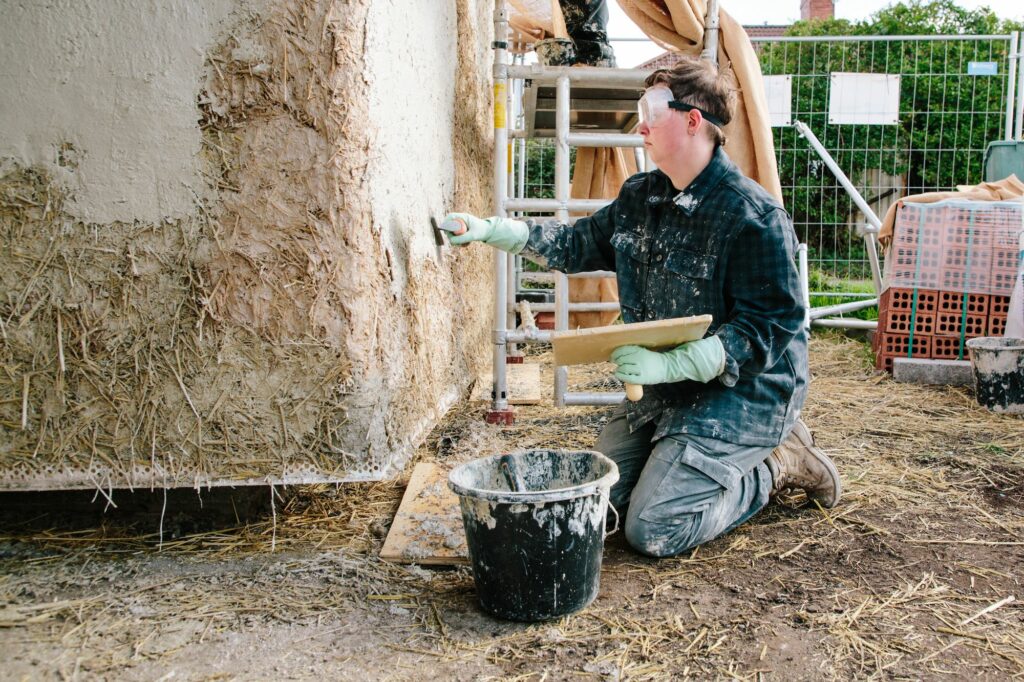 JK: I think you’ve hit the crux of it. Sustainability policies were created so that there was a measurable standard that everybody could live up to. It was good that there were means of ensuring the built environment would move towards a better standard. But at the same time, people are reluctant to change after standards are set. We’re currently in a situation where a lot of new material systems actually have no means of measurement. It’s difficult to prove that natural materials or systems could work or even perform better because they are always in flux. In-between spaces that are not heated but transition between inside and outside cannot be measured. Because of this, it’s difficult to convince clients to go with these kinds of solutions. Public clients often go for certified buildings over more performative and natural ones because the labels give them legitimacy. If we want to change the industry, we need to reconsider sustainability metrics and how we evaluate design. Bio-based materials and natural systems rely on the idea that buildings are porous and more closely related to their context. That means we don’t need the absolute perfect seal between inside and outside. We’re expanding the palette of materials, but we’re also expanding our values beyond absolute measurements. Regulations and metrics have yet to catch up.
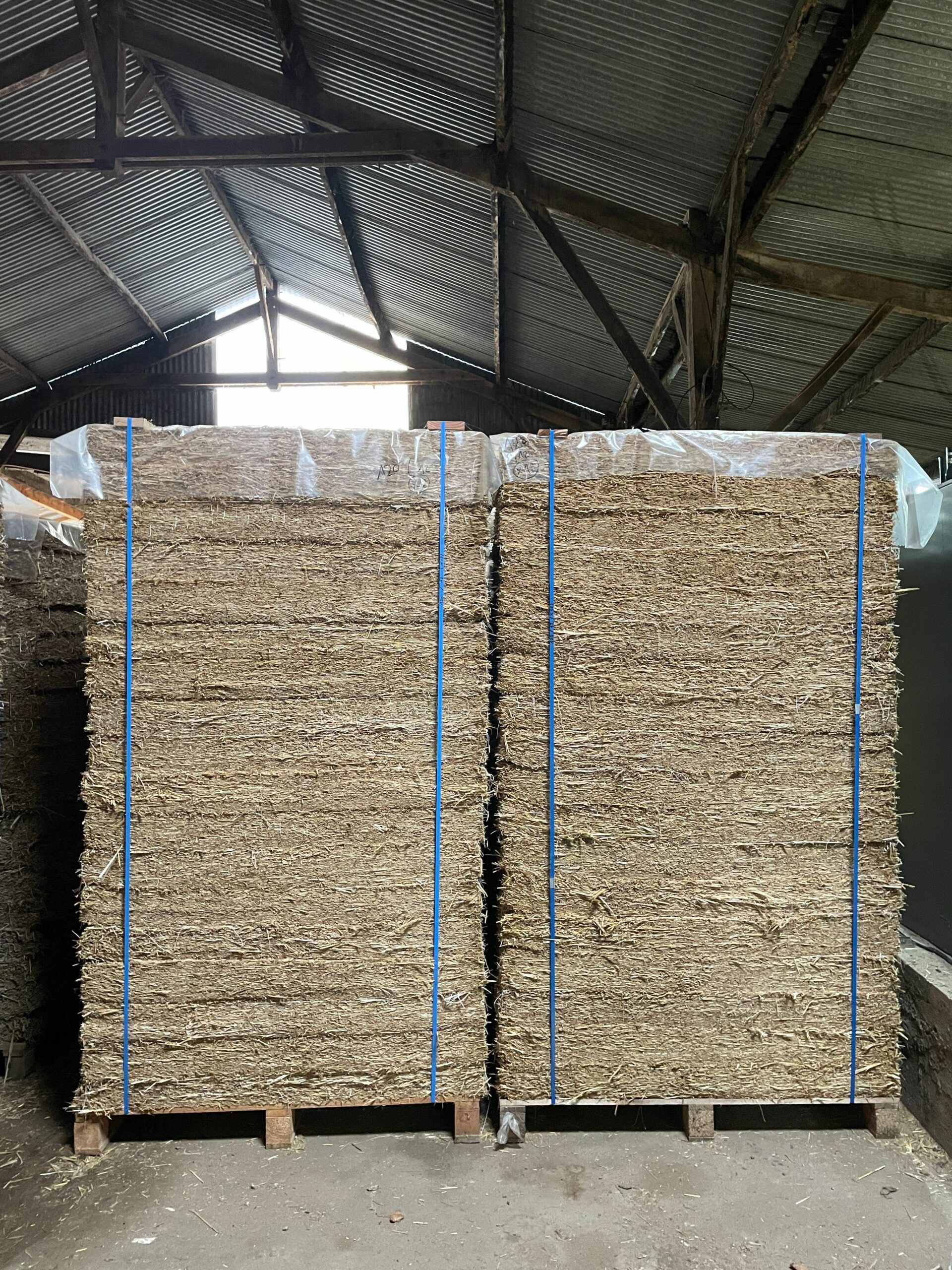
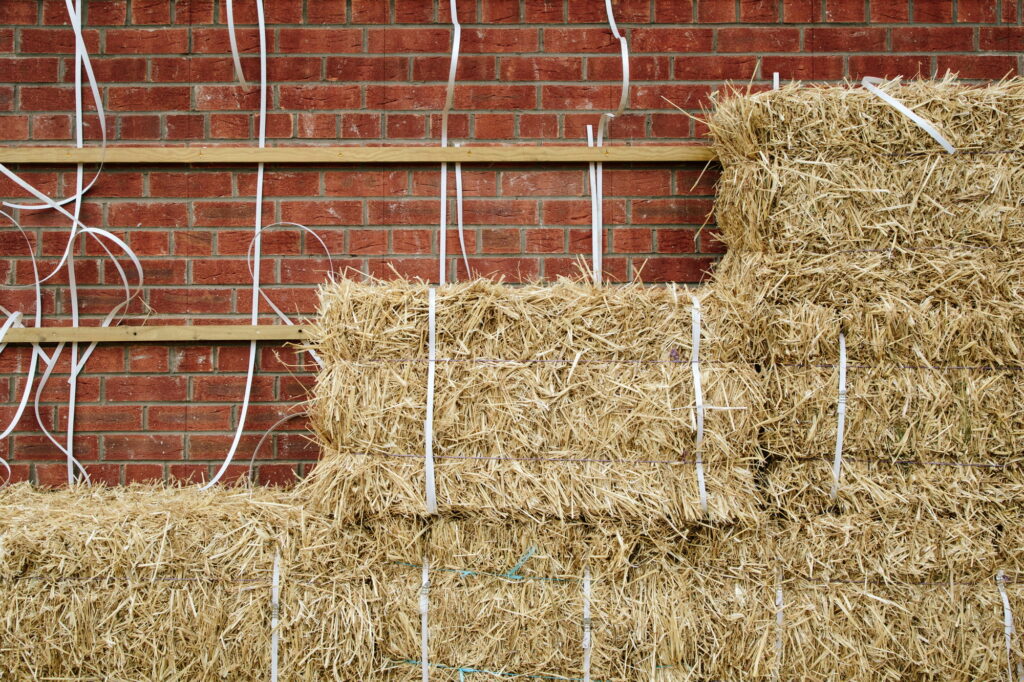
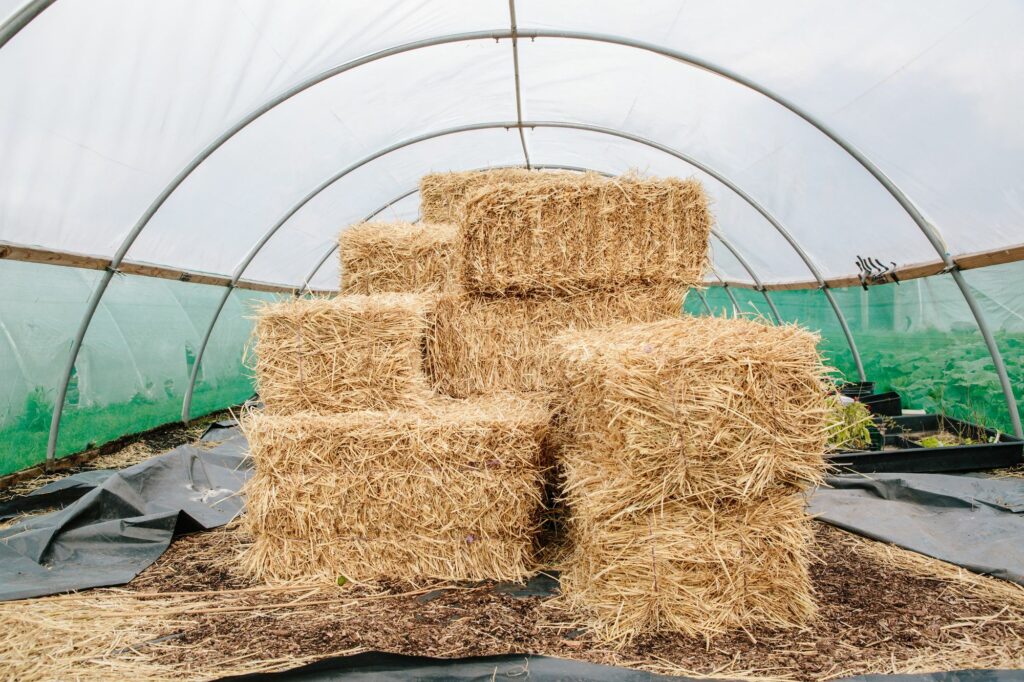
SI: Absolutely. Straw coming out of different farms is often is baled differently. Its material properties depend on how compacted it is. It depends where it was grown and what cultivar it was. All those variables mean that you can operate within a known range, but you don’t have the same guarantee and certainty that you get from a series of products that get stuck together, which provides a regular U-value and a regular moisture transmission value. That doesn’t mean you can’t have that information, but it does mean thinking differently about what information you’re looking for and having a conversation with every project about what it means to live with these materials.
 JK: It’s also transforming the way we speak with others about it. We’re talking about ranges and gradients. How do we develop the means to frame policy around something like that, not to mention communicate it to clients?
SI: Most of our emotional labor is spent trying to persuade clients that the things we know work really well will actually work really well. We have to do this over and over again because for our clients, the risk is ultimately financial. Building outside the norm means they aren’t able to get the same kinds of insurances and warranties that other people might. This is where policy could start to change, because it shouldn’t be necessary for a structural warranty system to look exactly the same way as the one that the certification company decided twenty years ago was the best way to build houses.
CMB: Can you elaborate on insurance?
SI: Fire is a huge concern in the British construction industry following the Grenfell tragedy. So timber buildings are controversial because there is a perceived fire risk. At the same time, as we advocate for using more sustainable materials, we also talk about using materials in ways where they’re not treated with chemicals. When we specify timber, we try to specify untreated timber. But fire retardant is a very important treatment in regulatory terms for timber to be used in buildings. Coatings are also the way that softwoods, which are cheaper, can prevent attacks from insects and pests. I recently learned that if a piece of wood is found in a peat bog by an archaeologist, one of the ways they can tell whether it was used in a house is whether it has woodworm. Essentially, all wooden dwellings up until relatively recently in human history had woodworm. But now there’s the idea that if your chair has woodworm, you have to take it outside and quarantine it; that it’s the worst thing that can happen to a timber frame. So I’m in a position now where I find myself advocating for something which essentially means asking my clients, “Would you like a house riddled with woodworm?” Obviously, no one’s going to say yes to that question.
CMB: I like to make fun of the tension between wishing to live with nonhumans and the discomfort that comes with that. When it comes to lice, mosquitoes, or mold, it is a battle against those who want to live in your house and are just as entitled to be there as you are. But it comes down to the question of how much we are willing to surrender in terms of comfort and control. The idea that we can eliminate risk and have a certain foresight about how we live is fraudulent. When our existing stock is retrofitted, it is wrapped in plastic—ultimately trash. Insulation is presented as the key to the energy transition, but the materials it mainly uses are polyurethane, phenol-formaldehyde resin, or rock wool—stone heated up to 1950 degrees Celsius. I advocate for temporarily nationalizing the insulation industry until it has transitioned to non-extractive materials.
 JK: The fallacy of previous approaches to sustainability was the certitude—the top-down approach of saying “we know the answer, we’re going to do it this way.” A lot of these recent discussions are about dismantling the myths of what sustainability was based on, like the myth of energy being the source of all evils, or timber as our savior. These slogans are too easy. Both of you grapple with entanglement in your work and don’t try to oversimplify. You embrace uncertainty.
CMB: I love uncertainty! Concrete, the pet material of modernity, is endlessly malleable and, once reinforced, well-performing structurally. Much R&D today seeks a silver bullet to replace concrete, avoiding change. But thinking systemically, we need to grasp the entirety of the supply chain of spatial production. For example, at the origin of a project, there is often a financial institution with loan-granting criteria that affects the way the land is treated and the design itself. So, perhaps loan types could be used to articulate a different kind of project. A change at the very beginning of the housing supply chain can have a massive impact on what is constructed. One could imagine grouped loans, where owners get better rates if they choose to build together, or less, or refurbish an existing building with virtuous materials, and so on. To me, this complexity is inspiring because it holds the seeds of change—it means the system can be reformed. A minor modification at a critical moment can shift paradigms. Donella Meadows argues that if you change something at a leverage point within large systems, then the whole system can shift. That is why we are interested in the possibility of dialogue between building experience and policy-making.
SI: The way we make buildings means that you might have uncertain material stocks. We’re working with whatever happens to be locally available, which can change with the climate. So, there’s an uncertainty factor in terms of short rotation crops. There’s also the weather, and building with natural materials is much more affected by rain, humidity, and temperature. There are so many uncertain variables that we operate with. At the same time, we’re trying to advocate that these things are a good idea, and these systems could scale. So, in any one project, we try to pin down some variables that don’t change, like working with timber. On the next project, maybe we’ll focus on foundation design and make that as low carbon as we can. We do this so that a project can still move ahead with relatively reasonable speed. Too much uncertainty in a project makes it difficult to progress. Focusing on one unconventional thing at a time also makes it easier for clients to feel comfortable taking the risk.
 JK: What do you think are the skills that we should be transmitting to students to adapt to this new awareness?
 You can read the original article at