A carefully optimized dose of fine biochar improves both carbon dioxide uptake and compressive strength in natural hydraulic lime, offering a promising low-carbon material for historic building restoration and sustainable construction.
Natural hydraulic lime has been used for centuries in masonry and restoration because it is compatible with traditional building materials and can absorb carbon dioxide as it hardens. Now, researchers have found that adding a small amount of finely ground biochar could strengthen this lime-based material while helping it capture more CO2.
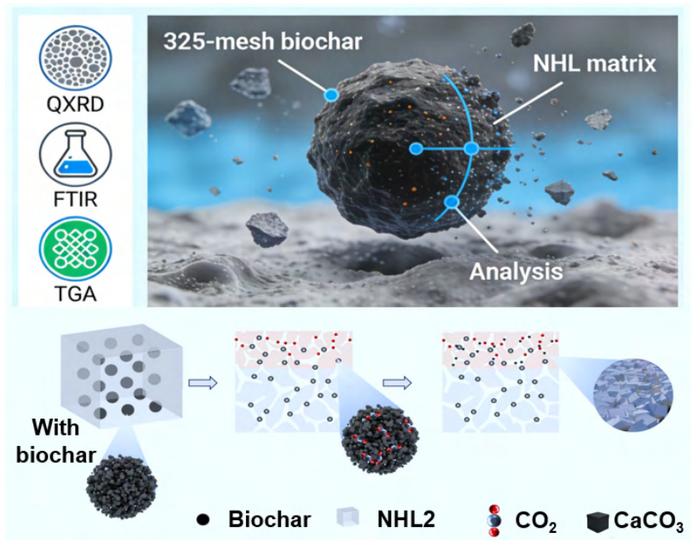 Researchers examined how different biochar particle sizes and dosages affected the mechanical properties, pore structure, carbonation behavior, and CO2 uptake of natural hydraulic lime. The best overall results were achieved by adding 2% biochar. Dosages above 2% increased porosity and weakened the continuity of the lime matrix. The optimized material showed a 35.7% increase in compressive strength after three days, a 42.1% increase after seven days, and a 10.9% increase after 28 days.
Natural hydraulic lime is produced at lower temperatures than conventional Portland cement and can absorb atmospheric CO2 through carbonation. During this process, calcium-containing compounds in the lime react with CO2 to form calcium carbonate, which can fill pores and strengthen the material.
Biochar, a carbon-rich porous material produced through the heating of biomass under limited oxygen, can store stable biomass-derived carbon for long periods. Its porous structure can also provide pathways and adsorption sites for gases.
You can read the original article at www.eurekalert.org