Plasters
The Beauty of Mud and Straw
What could be more basic to life on Earth than mud and straw? The dirt beneath your feet brings forth grasses that become straw. When you combine these two elements with loving care you can create an enduring beauty that will thrill your soul, and a home that will embrace and protect you. We have been experiencing a renaissance in the use of natural materials for building throughout the U. S. 
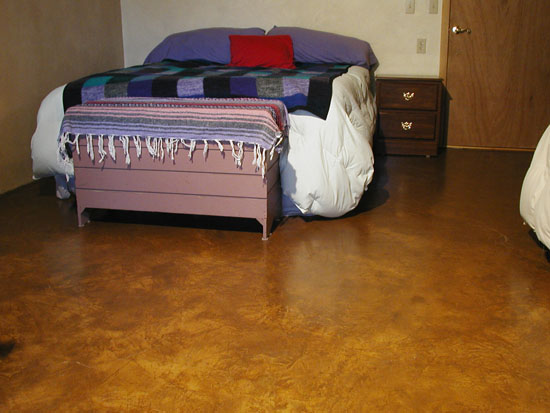
To make an earthen floor you need to add about 25% of finely screened clay to 75% sharp sand or crusher fines, with enough water to make something the consistency of a thick cake batter. Once this is thoroughly mixed, then several handfuls of chopped straw (several inches long) can be mixed in to help bind the material together and give the final floor some beautiful flecks of gold if desired.
This wet mixture is poured over a prepared base of thoroughly tamped road base (gravel and sand). The layer of adobe can be as thin as about ¾ inch, but usually it is more like about 2 inches. The first stage of pouring an adobe floor is similar to pouring concrete, where the wet material is roughly screed to get it uniformly level. With concrete, however, you must do all of the finish work within a few hours, before it sets up. With adobe the curing and finishing process can go on for weeks, or even months.
Biochar Plaster and Biochar Bricks
Biochar, a highly porous material produced from plant waste, is mostly used in agriculture as a soil conditioner, in livestock farming as a feed supplement, and in metalworking as a reducing agent. The latest developments at the Ithaka Institute are now focusing on its use as a building material.
10 Beautiful and Useful Things You Can Create with Earth Plaster
People are often fascinated by the structure of my earthbag home, but in truth that was the easy part. It’s the plaster that is an art. And a science. At times I thought it might have even been witchcraft. Because it took me just 6 weeks to build my earthbag house, but almost 2 years to get my plaster sitting beautifully on my walls without cracks or bits of it falling off.
How to Test and Make Exterior Render using Cow Poo

“It can take about two weeks to get your tests ready for this particular mix so make sure to leave enough time. You are going to need to do a number of tests before you find your ideal render, as the materials and the way they react to the environment are going to be different everywhere in the world. Even if you are living in a similar climate to us here, I would not recommend copying our mix as the clay, sand and poo you will be using will not likely be the same.”
Kyle’s Crazy House: Earthen Plaster on the Gnestle
“In this video, and the next few I post, I will be showcasing the buildings of Kyle Yoder, who’s lived at Dancing Rabbit ecovillage for several years and is known for the organic forms of his design. One of the great things about natural building is the freedom it gives builders to think beyond the 90 degree angle. Kyle’s just begun the finish plaster of his own home, the Gnestle, and we’re going to get a peek at his work and a little explanation from the builder himself.