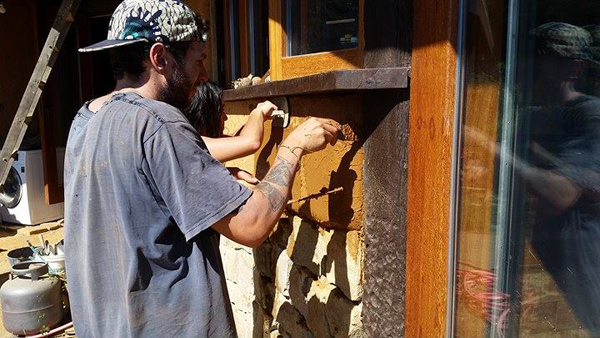
“It can take about two weeks to get your tests ready for this particular mix so make sure to leave enough time. You are going to need to do a number of tests before you find your ideal render, as the materials and the way they react to the environment are going to be different everywhere in the world. Even if you are living in a similar climate to us here, I would not recommend copying our mix as the clay, sand and poo you will be using will not likely be the same.”
Plasters
Kyle’s Crazy House: Earthen Plaster on the Gnestle
“In this video, and the next few I post, I will be showcasing the buildings of Kyle Yoder, who’s lived at Dancing Rabbit ecovillage for several years and is known for the organic forms of his design. One of the great things about natural building is the freedom it gives builders to think beyond the 90 degree angle. Kyle’s just begun the finish plaster of his own home, the Gnestle, and we’re going to get a peek at his work and a little explanation from the builder himself.
Earthen Plasters: The healthiest and most beautiful way to finish your home
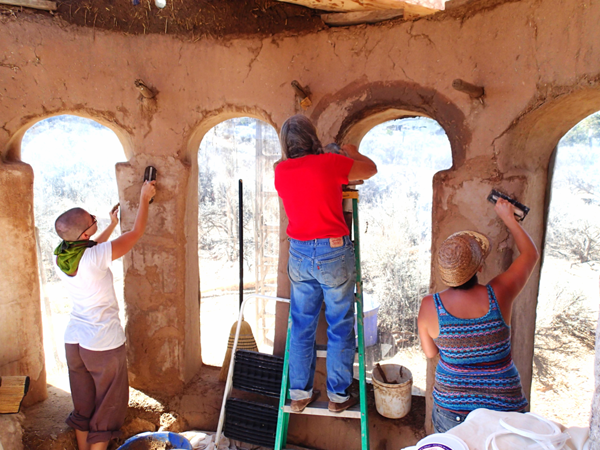
“No matter what material you build your house with, the finishes will always be the most visible part both inside and out. For thousands of years people have used natural materials to improve the appearance of their buildings, to protect their buildings from the elements, and to hide the rougher qualities of their walls. Despite advances in technology and industrial methods of production, most houses are still finished with natural plasters and renders. In this article we’ll explore the three most common types of plaster, discuss their benefits and limitations, and talk about why they’re the best option for home finishings, not only in natural homes, but in conventional homes too.
Rebuilding Nepal, One Earthbag at a Time
 Rebuilding Nepal, One Earthbag at a Time is a short Kindle book assembled by a team of eight volunteers who went to Palchok in the Trishuli Valley to rebuild a school in the fall of 2015. Because of the remote location they needed to plan for every aspect of the project, and this book is primarily advice for others who might try to do something similar. Besides actually building the school, they wanted to introduce the earthbag technique to the villagers so they could continue rebuilding this way. The team had raised enough funds from friends and family to accomplish this goal. They were there for only two weeks, but they got that small school built! Graeme Howell was the mastermind behind this endeavor.
The first chapter introduces what they consider to be the essential building process and suggests how to make this happen efficiently. Because of the number of volunteers, including folks from the village, they wanted to keep everybody busy and make sure there weren’t bottlenecks in the process. For this reason they had people filling and sewing bags right away, even before the foundation trench was prepared. Likewise, they had people screening soil for the eventual plaster.
Thermal Performance Data on an Earthbag Dome
Awhile ago, I wrote to you asking if you had any recommendations for stabilizing our 14′ (inner diameter) scoria dome tank house which had started to fail as a result of the bags breaking down. I wanted to give you an update.
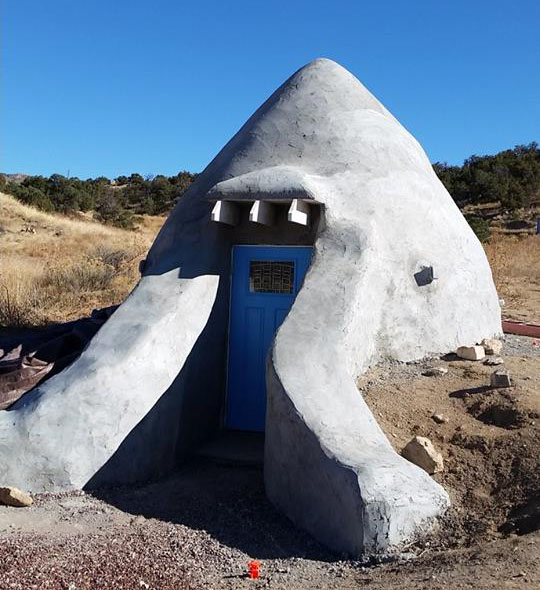
We paid a crew last November to shotcrete it inside and out, and it is performing very well. I just wish I knew whether it was the mass of concrete or the insulation of the bags. Probably a combo. I am interested to see how it performs once the mass has heated up a bit this summer.
Transforming an Airstream Trailer
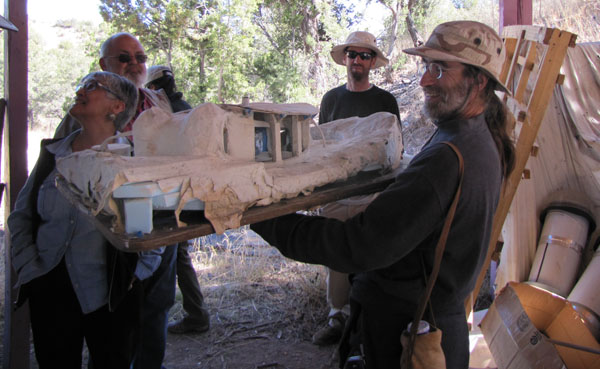 Our final stop on the tour of Asher Gelbart’s off-grid homestead was a work in progress of incorporating an old Airstream trailer into a larger architectural project. Asher is holding up a model of this concept, which would not only feature a spiral roof covering most of it, but also earthbag domes.
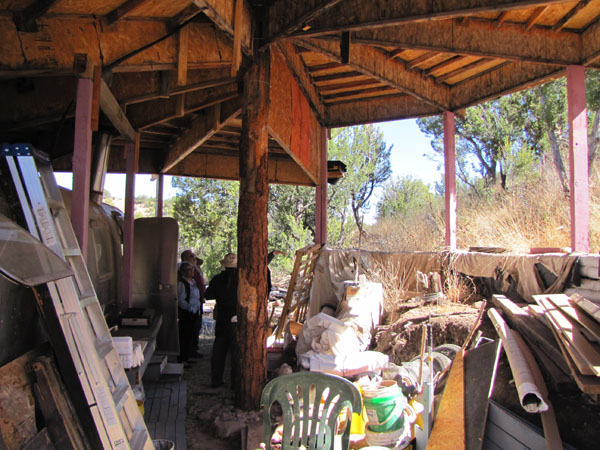
The roof structure was mostly intact, and some earthbag retaining walls were established, but much work still needed to be done to manifest this vision.