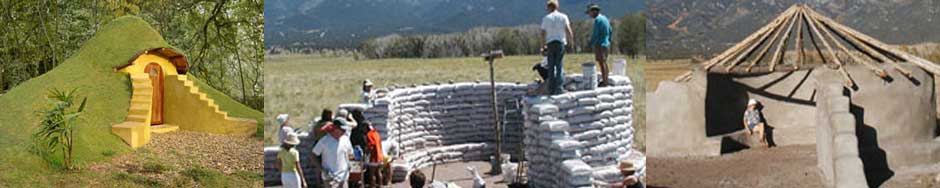
An Earthbag Privacy Wall

Wayne Talbot, a reader from South Africa, sent me these photos and description of an earthbag privacy wall that he just completed. I think that is very nicely done! Inspired by Owen’s earthbag building resources, I recently completed the construction of an earthbag boundary wall. 11m L x 2.5m high. Bags filled with building sand … Read more

Making Retaining Walls with Earthbags

I recently received this question about using a particular commercial product for making retaining walls:
“I’m ready to do an earthbag-style retaining wall project at the end slope of my front yard. I’m looking at an earthbag-style product called Flex MSE, which is basically UV-safe PPE material that can be sliced open to insert seeds or native plants. Flex MSE apparently strengthens as a retaining wall as vegetation becomes established. But the bags are specially formulated and have aforementioned UV-blocking properties, which is opposite of the much more affordable PPE earthbag that has to be shielded from the sun. The result of putting plant matter in a small slit in the Flex MSE bag is that the vegetation spreads and covers the bag, which makes UV protection unnecessary so long as it is fully developed in cover. Do you know of anyone who has cut small slits in plain earthbags for inserting plant matter? Would you recommend against it? I assume that plant coverage could protect a plain PPE bag from the sun, just as long as it is a vine or perennial that doesn’t recede during winter months (Zone six Western Pennsylvania here).”

Read more

The Beauty of Mud and Straw

What could be more basic to life on Earth than mud and straw? The dirt beneath your feet brings forth grasses that become straw. When you combine these two elements with loving care you can create an enduring beauty that will thrill your soul, and a home that will embrace and protect you. We have been experiencing a renaissance in the use of natural materials for building throughout the U. S.

To make an earthen floor you need to add about 25% of finely screened clay to 75% sharp sand or crusher fines, with enough water to make something the consistency of a thick cake batter. Once this is thoroughly mixed, then several handfuls of chopped straw (several inches long) can be mixed in to help bind the material together and give the final floor some beautiful flecks of gold if desired.

This wet mixture is poured over a prepared base of thoroughly tamped road base (gravel and sand). The layer of adobe can be as thin as about ¾ inch, but usually it is more like about 2 inches. The first stage of pouring an adobe floor is similar to pouring concrete, where the wet material is roughly screed to get it uniformly level. With concrete, however, you must do all of the finish work within a few hours, before it sets up. With adobe the curing and finishing process can go on for weeks, or even months.

Read more

Biochar Plaster and Biochar Bricks

Biochar, a highly porous material produced from plant waste, is mostly used in agriculture as a soil conditioner, in livestock farming as a feed supplement, and in metalworking as a reducing agent. The latest developments at the Ithaka Institute are now focusing on its use as a building material.

Read more

10 Beautiful and Useful Things You Can Create with Earth Plaster

People are often fascinated by the structure of my earthbag home, but in truth that was the easy part. It’s the plaster that is an art. And a science. At times I thought it might have even been witchcraft. Because it took me just 6 weeks to build my earthbag house, but almost 2 years to get my plaster sitting beautifully on my walls without cracks or bits of it falling off.

Read more

How to Test and Make Exterior Render using Cow Poo

Applying earthen render with cow manure

“It can take about two weeks to get your tests ready for this particular mix so make sure to leave enough time. You are going to need to do a number of tests before you find your ideal render, as the materials and the way they react to the environment are going to be different everywhere in the world. Even if you are living in a similar climate to us here, I would not recommend copying our mix as the clay, sand and poo you will be using will not likely be the same.”

Read more