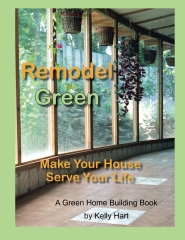
Remodel Green: Make Your House Serve Your Life

remodelgreenthumbnailHere’s a book hot off the press! It is always exciting to have the actual book in my hand and see the real manifestation of all those days of work. Remodel Green: Make Your House Serve Your Life is the second book in my series about green home building (the first was Rolling Shelter: Vehicles We Have Called Home) and it chronicles much of the personal remodeling I have done over my life.

I organized the chapters to focus on specific aspects of green remodeling, using examples from my experience to illustrate the points I make. The book is lavishly illustrated with photos from all of those projects, so it is a fun book to browse. My dear friend, Lee Temple from www.PrimaMundi.com, wrote a fine Foreword for the book, placing its message in the greater context of global environmental awareness. To remodel an existing structure to suit your needs is fundamentally a sustainable activity, because it means that you are salvaging a considerable amount of embodied energy rather than causing all of the new embodied energy that any new building would entail. 
Read more

300 earthbag homes for ‘Yolanda’ survivors to rise in Coron, Palawan

From yesterday’s www.businessmirror.com written by Jonathan L. Mayuga:

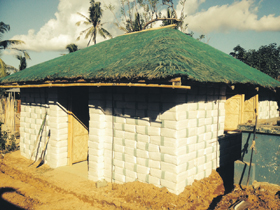
This type of environment-friendly earthbag homes will soon rise in Barangay Lajala, Coron, Palawan for the survivors of supertyphoon Yolanda. (Jonathan L. Mayuga)
This type of environment-friendly earthbag home will soon rise in Barangay Lajala, Coron, Palawan for the survivors of supertyphoon Yolanda. (Jonathan L. Mayuga)

CORON, Palawan—Eco-friendly earthbag homes for Supertyphoon Yolanda survivors will soon rise in Barangay Lajala, one of the coastal barangays devastated by the super typhoon in this island municipality last year.

Mayor Carla “Fems” Reyes said the island municipality is planning to construct 300 earthbag homes for those who remain homeless after Yolanda triggered a storm surge that swept away thousands of houses along coastal towns in Central Philippines.

The earthbag homes, with a floor area of 24 square meter, will have one bedroom, one comfort room and a concrete floor, according to a plan approved by the local government of Coron.

Instead of ordinary hollow blocks, a mixture of cement and soil—one part cement and seven parts soil—was used to make bricks that would be used for the walls of the house. For the roofs, doors and windows, bamboo poles or kawayan and nipa will be used.

Read more

Earthbag Building in Kenya

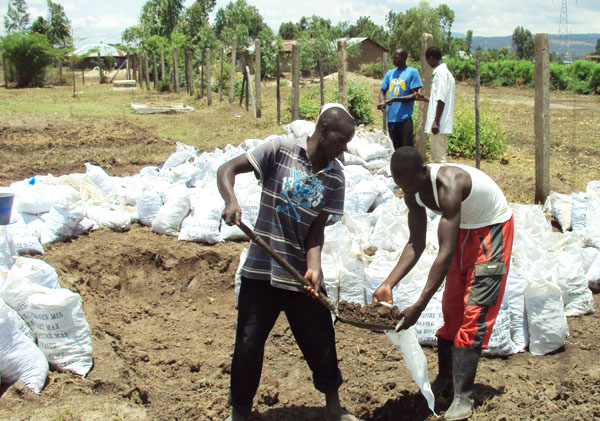
We are always pleased to hear from people around the world about their building projects. I recently received this email, along with several photos:

“Dear Kelly I have seen your inspiring works with earthbags and am happy to inform you that I am also into green building here in Kenya. I have done a demo house using earthbags and will be going for the next level of building as an eco-friendly training school using this method. We would want to include off grid power eventually, but that is for the future.  Regards, Barry Kungu”

Filling the earthbags

Read more

The Owner Built Homestead — Free Form Architecture

Free-form house by Andre Bloc

“Ken Kern, author of The Owner-Built Home and The Owner-Built Homestead, is an amazing fellow and everyone interested in decentralist, back-to-the-land, rational living should know of his work. Back in 1948 he began collecting information on low-cost, simple and natural construction materials and techniques. He combed the world for ideas, tried them and started writing about his experiments.

Read more

Sean’s Adobe House

sean1

Within the same alternative community as Ted’s ruins (see the previous post) is Sean’s Adobe House, also featured in my Sampler of Alternative Homes video. Sean Sands built this house about 20 years ago for less than $1,000. He used the native soil, which is an almost perfect adobe mix of about 25% clay and 75% sand. All he would do is moist the soil where he wanted to harvest adobe the night before he planned to dig it. Then he placed the damp soil in a hydraulic ram press to make compressed earth blocks. He would let these cure in the sun for a few days before building with them. Part of the walls of the house were made with old tires packed with soil.

Read more

Ark Soaring in the Sky

school-with-children-and-teacher

Kikuma Watanabe is an associate professor at Kochi University of Technology in Japan and is responsible for the overall design of this project. The owner is Kagayaku Inochi (glorious life), a Japanese NPO. This school for orphans is in Sangkhlaburi village, Thailand, located near the borderline between Thailand and Myanmar. In this area there are a lot of poor people who immigrated from Myanmar.  This school aims to provide sustainable poverty alleviation in the area.

To provide a good future for the children, they hoped that the school would be designed to realize their dreams. So, at first the teacher asked the children to draw the dream of the school building. One of them drew a flying ship as his dream. They adapted his idea, and tried to translate the drawing into architecture.

Read more