Hempcrete

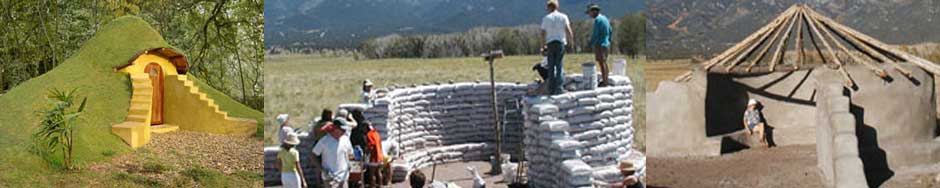
I’ve been aware of the value of what is called “hempcrete,” a mixture of lime and hemp hurds (an agricultural byproduct), for several years. But I’ve never learned much about how to prepare it, partly because industrial hemp cultivation has been illegal in the United States for the last eight decades, since it is related … Read more

Does Insulating Paint Really Work?

For many years I have wondered about the effectiveness of various products that advertise that they can insulate roofs and walls by simply painting them! The technology is said to stem from the science (developed by NASA) of protecting space vehicles by coating them with tiny ceramic spheres that reflect heat, so that they don’t burn up when re-entering the atmosphere. Some products consist of an additive for paint, while others are specially formulated paint.

When I realized that I wanted to insulate the 1940’s adobe house I had bought, I began to wonder whether this might be a simple solution to accomplish this. In researching this possibility I discovered that there were conflicting opinions about whether such a paint could work. The manufacturers claimed that many tests have proven their effectiveness and there were some testimonials from individuals or businesses that made similar claims. But I couldn’t find any independent studies that I considered actual validation of the concept.

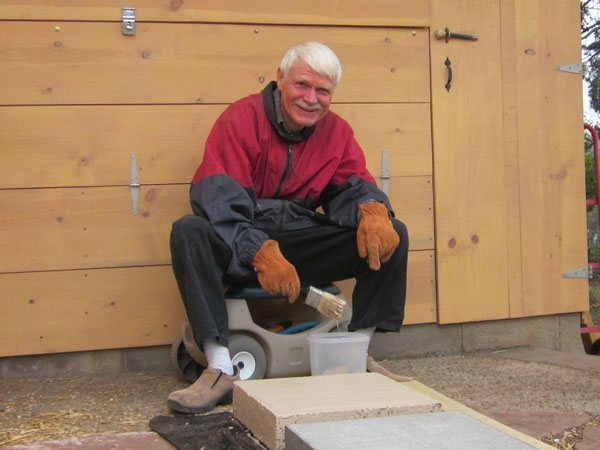
Not being willing to proceed blindly with painting my entire house with expensive paint on the assumption that it would improve the thermal dynamics of my completely thermal mass walls, I decided to conduct an experiment that would accurately inform me exactly how effective the paint might be. I conceived of a situation that would simulate the thermal mass walls that were left open to the ambient atmosphere over several days. There would be one setup painted as prescribed with the insulating paint and then a second control setup that was identical, except without the insulating additive. Embedded within each of these would be a wireless thermometer probe to keep track of the separate interior temperatures.
painting

I found some perfectly uniform 16’X16″X3.5″ concrete blocks for sale at my local building supply store quite cheaply, so I bought ten of these. Next I acquired the insulating additive (Insuladd was the brand name) and used some exterior latex paint that I already had on hand. I thoroughly mixed the additive to some of the paint and kept some of it in its original form for the control. Then I painted half of the concrete blocks with the insulating paint and half with the control paint, applying two coats of each.

Read more

Eco-Homes: People, Place and Politics

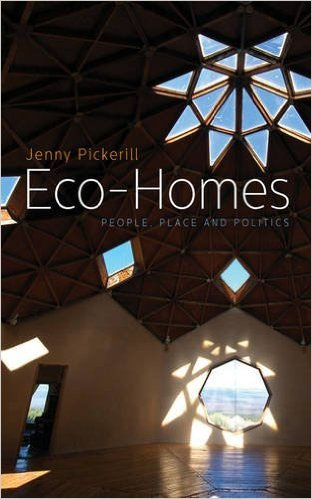
Jenny Pickerill is a professor of environmental geography at the University of Sheffield, and I met her when she was conducting research for this book, gallivanting around the world on a Winston Churchill Memorial Trust Travel Fellowship. She interviewed me and we toured a variety of novel eco-homes near Crestone, Colorado, where I was living at the time. In addition to Crestone, she visited ecological enclaves in Britain, Spain, Thailand, Argentina and other locations in the United States.

ecohomes

Her purpose in assembling this academic study into ecological living was to focus more on the social, geographical and political issues around eco-housing, which are often ignored, in the hopes that a broader acceptance of sustainable architecture will evolve. I found her analysis enlightening and well worth the read, if a bit academic in its outlook. Each chapter of the book is devoted to a different filter, which in total provides a good understanding of the issues involved.

The first chapter focuses on the eco aspects of eco-homes, and why this is important.  She observes that “eco-houses are being built to deal with the issues of waste through structural innovations by altering size, harnessing renewable technologies, retrofitting existing housing stock and changing occupants’ behavior and practices. Each approach has benefits, limitations and financial costs.” She goes on to chastise government and industry for emphasizing the technical fixes while ignoring simpler solutions.

Next, Jenny delves into the home aspect explaining how hard it is to define what home really is. Home can generally refer to country, state, city, bioregion, neighborhood, as well as a specific house. We have an emotional attachment to our homes that must be recognized in order to make eco-houses appealing to a wider audience. The emotional component is affected by aesthetics, location, style, privacy, comfort, and worth.

Read more

The Spiritual Ecology Youth Fellowship Programme

“Our new spiritual ecology programme starts in September 2016. We are seeking 10 exceptional and visionary young adults (between 20 and 32 years) – individuals with committed spiritual lives, who are passionate about the Earth, and have the potential to be catalysts for real change. Young people who recognise the need to create a future that is rooted in the values of interconnectedness, service, stewardship, and reverence for nature. This is open to all European nationals.

Read more

The Eco-Home Design Guide

ecohomedesign

Christopher Day is a veteran of the world of architecture in Britain. In his new book, The Eco-Home Design Guide: Principles and practice for new-build and retrofit, he has condensed his considerable experience of both designing and hands-on building into a set of guiding principles for how to go about your own ecological building project.

The book is well organized into primary divisions that deal with the major issues that confront anyone who undertakes such a journey. These what, where, how and when issues are each examined in turn, so that by the time you complete the book, you should have a good understanding of all of the issues that need to be addressed. Each chapter is summarized at the end with a listing of the key points covered and a chart of the main choices that need to be made. With this approach, you can quickly thumb through the book to review the basic information presented.

Read more