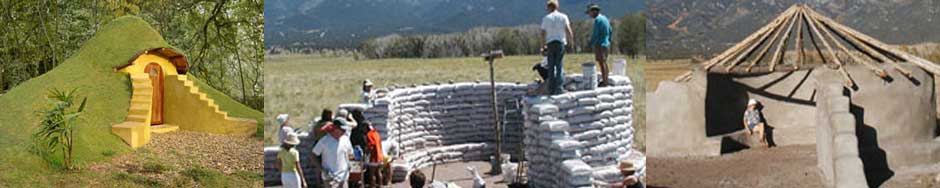
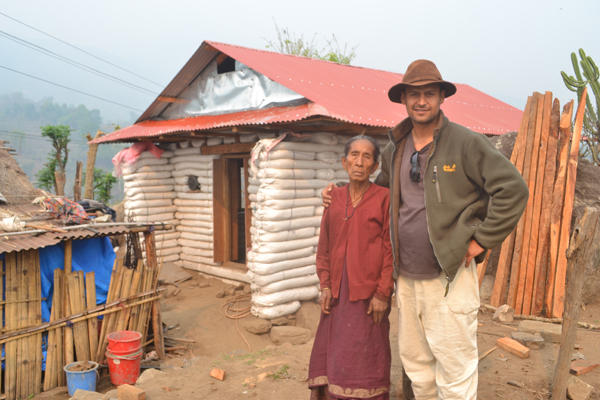
“Initially, on paper, I figured that it would be cheap to build earthbag houses. After many years of research, while I was studying and working in the UK, and after the twin earthquakes of 2015, it made more sense to me to give this method a try and promote it. I finally made the jump and started building a small earthbag home for the sweet old lady from my community here in Chiti VDC Lamjung. I found some hidden surprises associated with the build.
Owen Geiger
Report from Nepal
I just received this news from Owen Geiger, who has been in Nepal for several days, reviewing earthbag projects around the country. “Things are WAY more hectic than I even imagined. Traveling to projects in the remote mountains is just grueling. The roads in Nepal are among the worst in the world. It takes hours … Read more
Green Magic Homes
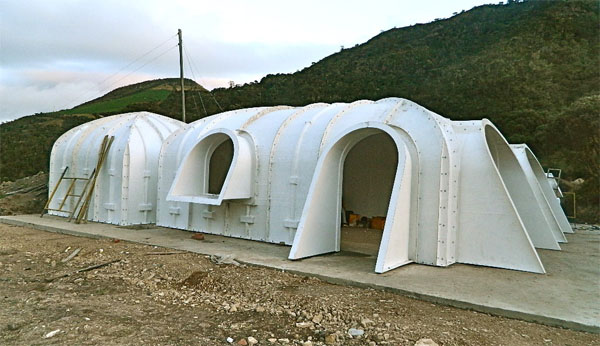
I stumbled upon an interesting approach to creating underground housing. The manufacturer of the system calls them Green Magic Homes. Basically the structures are composed of prefabricated sections of molded composite material that are connected together to create a variety of shapes. They are waterproof and will not rot, so they are quite durable. Once the sections are erected, which can happen very quickly, they can be coated on the outside with foam insulation (generally needed in most climates). The idea is to cover the whole house with earth to protect it and to take advantage of the thermal benefit of going underground. Unfortunately, the system can only support about 7 inches of soil, so if you want more than that it may be necessary to add additional reinforced concrete.
Thermal Performance Data on an Earthbag Dome
Awhile ago, I wrote to you asking if you had any recommendations for stabilizing our 14′ (inner diameter) scoria dome tank house which had started to fail as a result of the bags breaking down. I wanted to give you an update.
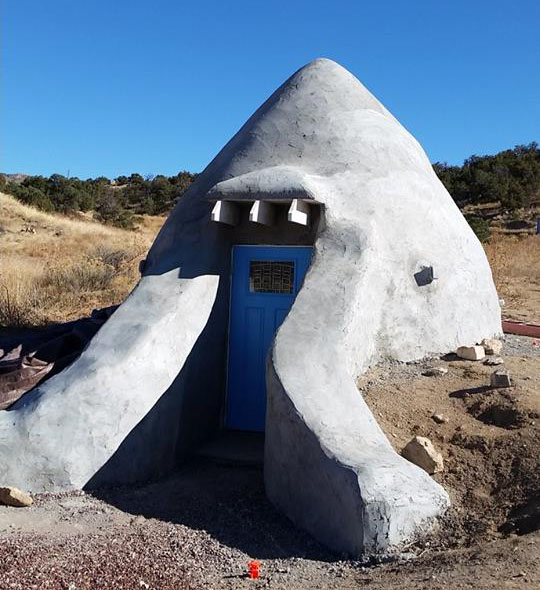
We paid a crew last November to shotcrete it inside and out, and it is performing very well. I just wish I knew whether it was the mass of concrete or the insulation of the bags. Probably a combo. I am interested to see how it performs once the mass has heated up a bit this summer.
A Unique Fire Pit
Clay DiMeno has been up to his usual tricks, building a unique fire pit at his Texas property. Here you can see him adding faux stone plaster to the arch. Both the bench and the ring around the fire pit were fashioned with earthbags. In this photo you can see how he has begun to … Read more
Does Insulating Paint Really Work?
For many years I have wondered about the effectiveness of various products that advertise that they can insulate roofs and walls by simply painting them! The technology is said to stem from the science (developed by NASA) of protecting space vehicles by coating them with tiny ceramic spheres that reflect heat, so that they don’t burn up when re-entering the atmosphere. Some products consist of an additive for paint, while others are specially formulated paint.
When I realized that I wanted to insulate the 1940’s adobe house I had bought, I began to wonder whether this might be a simple solution to accomplish this. In researching this possibility I discovered that there were conflicting opinions about whether such a paint could work. The manufacturers claimed that many tests have proven their effectiveness and there were some testimonials from individuals or businesses that made similar claims. But I couldn’t find any independent studies that I considered actual validation of the concept.
Not being willing to proceed blindly with painting my entire house with expensive paint on the assumption that it would improve the thermal dynamics of my completely thermal mass walls, I decided to conduct an experiment that would accurately inform me exactly how effective the paint might be. I conceived of a situation that would simulate the thermal mass walls that were left open to the ambient atmosphere over several days. There would be one setup painted as prescribed with the insulating paint and then a second control setup that was identical, except without the insulating additive. Embedded within each of these would be a wireless thermometer probe to keep track of the separate interior temperatures.
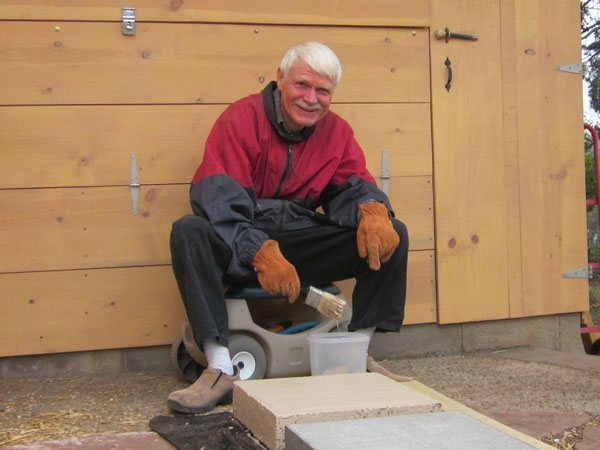
I found some perfectly uniform 16’X16″X3.5″ concrete blocks for sale at my local building supply store quite cheaply, so I bought ten of these. Next I acquired the insulating additive (Insuladd was the brand name) and used some exterior latex paint that I already had on hand. I thoroughly mixed the additive to some of the paint and kept some of it in its original form for the control. Then I painted half of the concrete blocks with the insulating paint and half with the control paint, applying two coats of each.