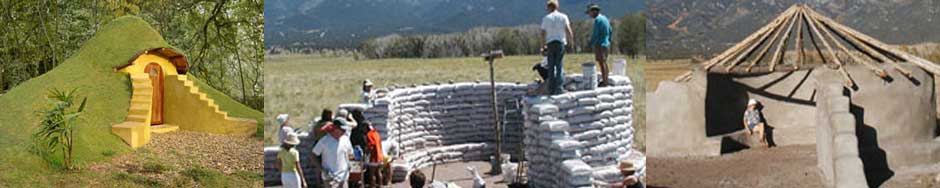
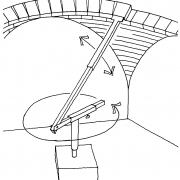
I realized it would be easy to make giant earthbag scoria blocks with raschel mesh bags, scoria (lightweight lava rock) and quick setting cement mortar or glue. The basic block making process involves forming the scoria blocks in simple wooden forms and then curing in the shade. The dome is built using standard brick dome building methods that brick masons already know or knowledge can be readily found on the Internet and in books.
Insulation
Weaving Studio Plan
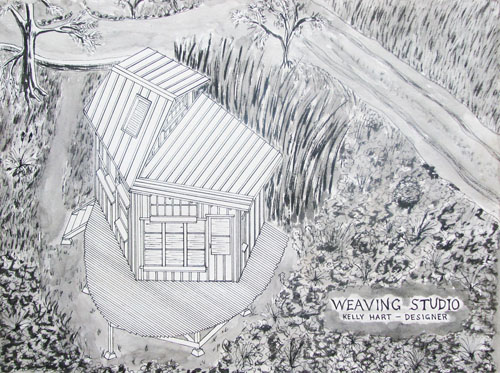
In the early 1970’s I was commissioned to design and build a small weaving studio on property located along the coast in Bolinas, California. The client was a weaving apprentice with my sister, who was living on rented property with her family. There was room on that property to place a small studio separated from the main house, and that is where she wanted me to build the studio. Obviously it would be foolish to place a permanent structure on rented property, so I suggested that I design it in such a way that it could fairly easily be dismantled and moved elsewhere if necessary. She liked the idea, so that is what I did.
Building an Earthbag and Stone Rainwater Storage Cellar
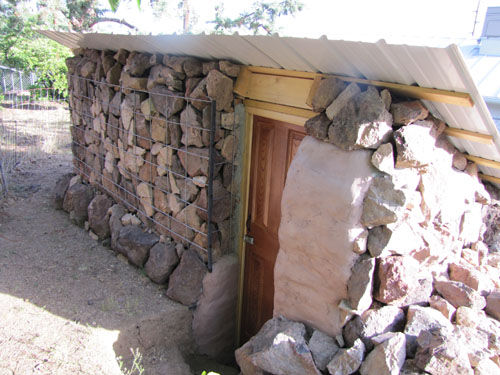
I decided to build a simple recessed cellar in my yard that would serve a variety of functions, including rainwater storage, root cellar and space for vermiculture (worm bins). All of these require relatively cool but not freezing conditions, so digging into the ground was a good way to accomplish this. It seemed like the easiest approach would be to build this primarily with earthbags.
First I calculated how large it needed to be in order to hold the two large (275 gallon) water tanks I intended to buy, as well as provide enough space for produce and worms. It was a tricky business to fit all of this in the space available, especially because I had to work between existing underground irrigation pipes.
Recycled Glass Insulation
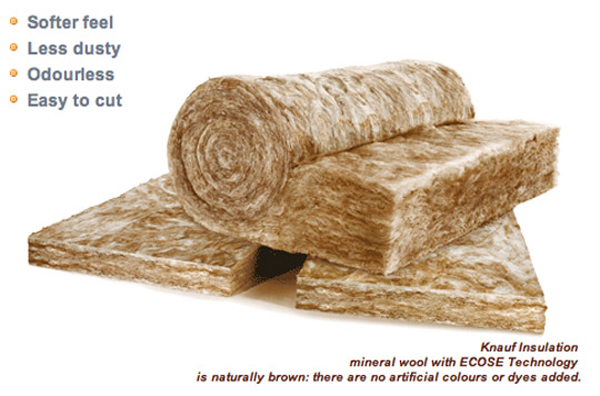
I’m always on the lookout for sustainable natural building materials. Recycled glass insulation is not only made in part with recycled glass, it’s also effective at reducing energy costs and improving the acoustics in homes and businesses. EcoBatt insulation caught my eye because it appears to be the largest brand of recycled, non-toxic glass insulation in the US. A few other brands are listed below, some of which are available in Europe.
Hempcrete
I’ve been aware of the value of what is called “hempcrete,” a mixture of lime and hemp hurds (an agricultural byproduct), for several years. But I’ve never learned much about how to prepare it, partly because industrial hemp cultivation has been illegal in the United States for the last eight decades, since it is related … Read more
Green Magic Homes
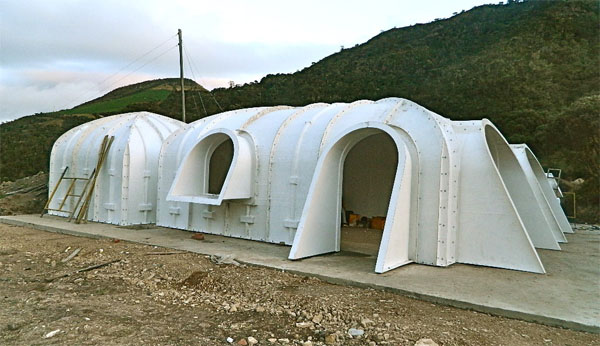
I stumbled upon an interesting approach to creating underground housing. The manufacturer of the system calls them Green Magic Homes. Basically the structures are composed of prefabricated sections of molded composite material that are connected together to create a variety of shapes. They are waterproof and will not rot, so they are quite durable. Once the sections are erected, which can happen very quickly, they can be coated on the outside with foam insulation (generally needed in most climates). The idea is to cover the whole house with earth to protect it and to take advantage of the thermal benefit of going underground. Unfortunately, the system can only support about 7 inches of soil, so if you want more than that it may be necessary to add additional reinforced concrete.