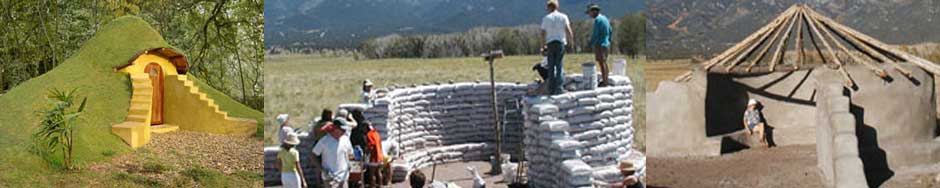
Bamboo’s Green Potential

An article in Eco-Business News describes some of  the amazing characteristics and uses for humble bamboo.  Like all plants, bamboo stores carbon. However, because it grows particularly fast—some species grow up to 90cm a day—and matures within a few years, it can be harvested regularly. This means bamboo can create a large number of durable … Read more

Natural Building with Balecob

The current issue of Mother Earth News has this article written by Kyle Chandler-Isacksen with Conrad Rogue; photos by House Alive. What is shown here are excerpts; you can read the entire article at the above link. Balecob is an infill technique that uses straw bales and cob to quickly create highly insulating, roof-supporting, and … Read more

The Beauty of Mud and Straw

What could be more basic to life on Earth than mud and straw? The dirt beneath your feet brings forth grasses that become straw. When you combine these two elements with loving care you can create an enduring beauty that will thrill your soul, and a home that will embrace and protect you. We have been experiencing a renaissance in the use of natural materials for building throughout the U. S.
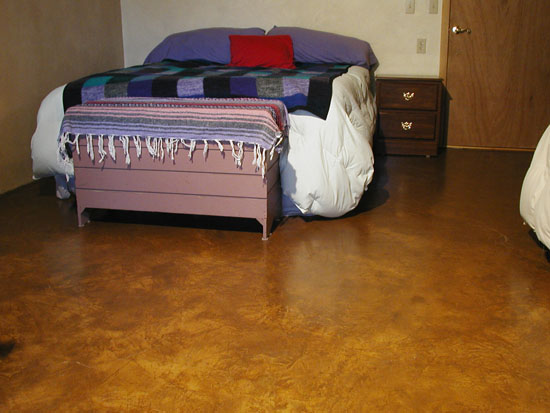
To make an earthen floor you need to add about 25% of finely screened clay to 75% sharp sand or crusher fines, with enough water to make something the consistency of a thick cake batter. Once this is thoroughly mixed, then several handfuls of chopped straw (several inches long) can be mixed in to help bind the material together and give the final floor some beautiful flecks of gold if desired.

This wet mixture is poured over a prepared base of thoroughly tamped road base (gravel and sand). The layer of adobe can be as thin as about ¾ inch, but usually it is more like about 2 inches. The first stage of pouring an adobe floor is similar to pouring concrete, where the wet material is roughly screed to get it uniformly level. With concrete, however, you must do all of the finish work within a few hours, before it sets up. With adobe the curing and finishing process can go on for weeks, or even months.
Read more

Rebuilding Nepal, One Earthbag at a Time

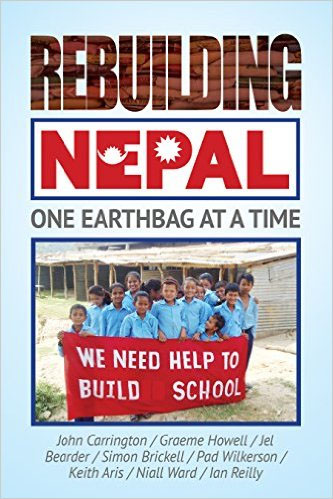
rebuildingnepalRebuilding Nepal, One Earthbag at a Time is a short Kindle book assembled by a team of eight volunteers who went to Palchok in the Trishuli Valley to rebuild a school in the fall of 2015. Because of the remote location they needed to plan for every aspect of the project, and this book is primarily advice for others who might try to do something similar. Besides actually building the school, they wanted to introduce the earthbag technique to the villagers so they could continue rebuilding this way. The team had raised enough funds from friends and family to accomplish this goal. They were there for only two weeks, but they got that small school built! Graeme Howell was the mastermind behind this endeavor.

The first chapter introduces what they consider to be the essential building process and suggests how to make this happen efficiently. Because of the number of volunteers, including folks from the village, they wanted to keep everybody busy and make sure there weren’t bottlenecks in the process. For this reason they had people filling and sewing bags right away, even before the foundation trench was prepared. Likewise, they had people screening soil for the eventual plaster.

Read more

The Eco-Home Design Guide

ecohomedesign

Christopher Day is a veteran of the world of architecture in Britain. In his new book, The Eco-Home Design Guide: Principles and practice for new-build and retrofit, he has condensed his considerable experience of both designing and hands-on building into a set of guiding principles for how to go about your own ecological building project.

The book is well organized into primary divisions that deal with the major issues that confront anyone who undertakes such a journey. These what, where, how and when issues are each examined in turn, so that by the time you complete the book, you should have a good understanding of all of the issues that need to be addressed. Each chapter is summarized at the end with a listing of the key points covered and a chart of the main choices that need to be made. With this approach, you can quickly thumb through the book to review the basic information presented.

Read more