Green Magic Homes

gm1

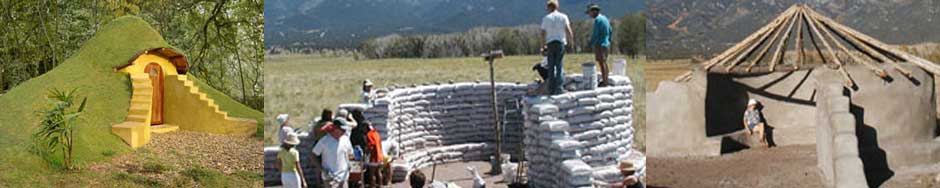
I stumbled upon an interesting approach to creating underground housing. The manufacturer of the system calls them Green Magic Homes. Basically the structures are composed of prefabricated sections of molded composite material that are connected together to create a variety of shapes. They are waterproof and will not rot, so they are quite durable. Once the sections are erected, which can happen very quickly, they can be coated on the outside with foam insulation (generally needed in most climates). The idea is to cover the whole house with earth to protect it and to take advantage of the thermal benefit of going underground. Unfortunately, the system can only support about 7 inches of soil, so if you want more than that it may be necessary to add additional reinforced concrete.

Read more

Thermal Performance Data on an Earthbag Dome

Awhile ago, I wrote to you asking if you had any recommendations for stabilizing our 14′ (inner diameter) scoria dome tank house which had started to fail as a result of the bags breaking down. I wanted to give you an update.

Beldar
We paid a crew last November to shotcrete it inside and out, and it is performing very well. I just wish I knew whether it was the mass of concrete or the insulation of the bags. Probably a combo. I am interested to see how it performs once the mass has heated up a bit this summer.

Read more

Does Insulating Paint Really Work?

For many years I have wondered about the effectiveness of various products that advertise that they can insulate roofs and walls by simply painting them! The technology is said to stem from the science (developed by NASA) of protecting space vehicles by coating them with tiny ceramic spheres that reflect heat, so that they don’t burn up when re-entering the atmosphere. Some products consist of an additive for paint, while others are specially formulated paint.

When I realized that I wanted to insulate the 1940’s adobe house I had bought, I began to wonder whether this might be a simple solution to accomplish this. In researching this possibility I discovered that there were conflicting opinions about whether such a paint could work. The manufacturers claimed that many tests have proven their effectiveness and there were some testimonials from individuals or businesses that made similar claims. But I couldn’t find any independent studies that I considered actual validation of the concept.

Not being willing to proceed blindly with painting my entire house with expensive paint on the assumption that it would improve the thermal dynamics of my completely thermal mass walls, I decided to conduct an experiment that would accurately inform me exactly how effective the paint might be. I conceived of a situation that would simulate the thermal mass walls that were left open to the ambient atmosphere over several days. There would be one setup painted as prescribed with the insulating paint and then a second control setup that was identical, except without the insulating additive. Embedded within each of these would be a wireless thermometer probe to keep track of the separate interior temperatures.

painting

I found some perfectly uniform 16’X16″X3.5″ concrete blocks for sale at my local building supply store quite cheaply, so I bought ten of these. Next I acquired the insulating additive (Insuladd was the brand name) and used some exterior latex paint that I already had on hand. I thoroughly mixed the additive to some of the paint and kept some of it in its original form for the control. Then I painted half of the concrete blocks with the insulating paint and half with the control paint, applying two coats of each.

Read more

The Eco-Home Design Guide

ecohomedesign

Christopher Day is a veteran of the world of architecture in Britain. In his new book, The Eco-Home Design Guide: Principles and practice for new-build and retrofit, he has condensed his considerable experience of both designing and hands-on building into a set of guiding principles for how to go about your own ecological building project.

The book is well organized into primary divisions that deal with the major issues that confront anyone who undertakes such a journey. These what, where, how and when issues are each examined in turn, so that by the time you complete the book, you should have a good understanding of all of the issues that need to be addressed. Each chapter is summarized at the end with a listing of the key points covered and a chart of the main choices that need to be made. With this approach, you can quickly thumb through the book to review the basic information presented.

Read more

Texas Stonehenge

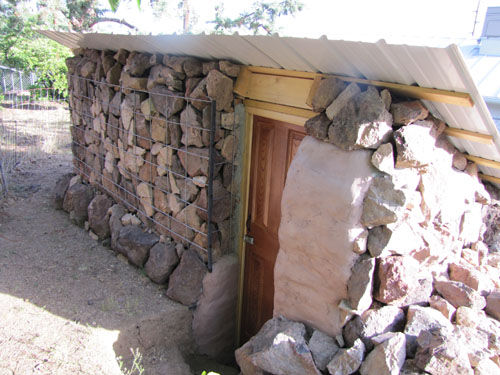
Texas Stonehenge is what Clay DiMeno calls this bunker/tornado shelter/man cave that he made with earthbags and a lot of creative ingenuity. IMG_3053Most people would not realize that this roundhouse was actually made from earthbags, because of Clay’s faux stone rendering. This is similar to a root cellar that he made and we featured earlier.

Read more

Mainstreaming Natural Building

breakout

At the recent Natural Building Colloquium in New Mexico, besides all of the workshops and presentations already mentioned in earlier blog posts, there were a number of fairly spontaneous breakout groups or conversations. I participated in a couple these; one was about the future of book publishing, but the most interesting one was looking at how we can bring natural building more into mainstream acceptance. This turned out to be a three day ongoing brainstorm with up to a dozen people at each session.

Janell Kapoor of Kleiwerks International proposed this discussion and it attracted many of the seasoned movers and shakers of the natural building movement. Joe Kennedy became the scribe, keeping 9 pages of notes of comments as they emerged.

Janell suggested doing a SWOT analysis, or looking at strengths, weaknesses, opportunities and threats to accomplishing the goal of advancing natural building to become more commonly accepted practice. Rather than outline all of the collected suggestions, I will give you my opinion about these aspects.

Read more